The Discovery That Changed Everything
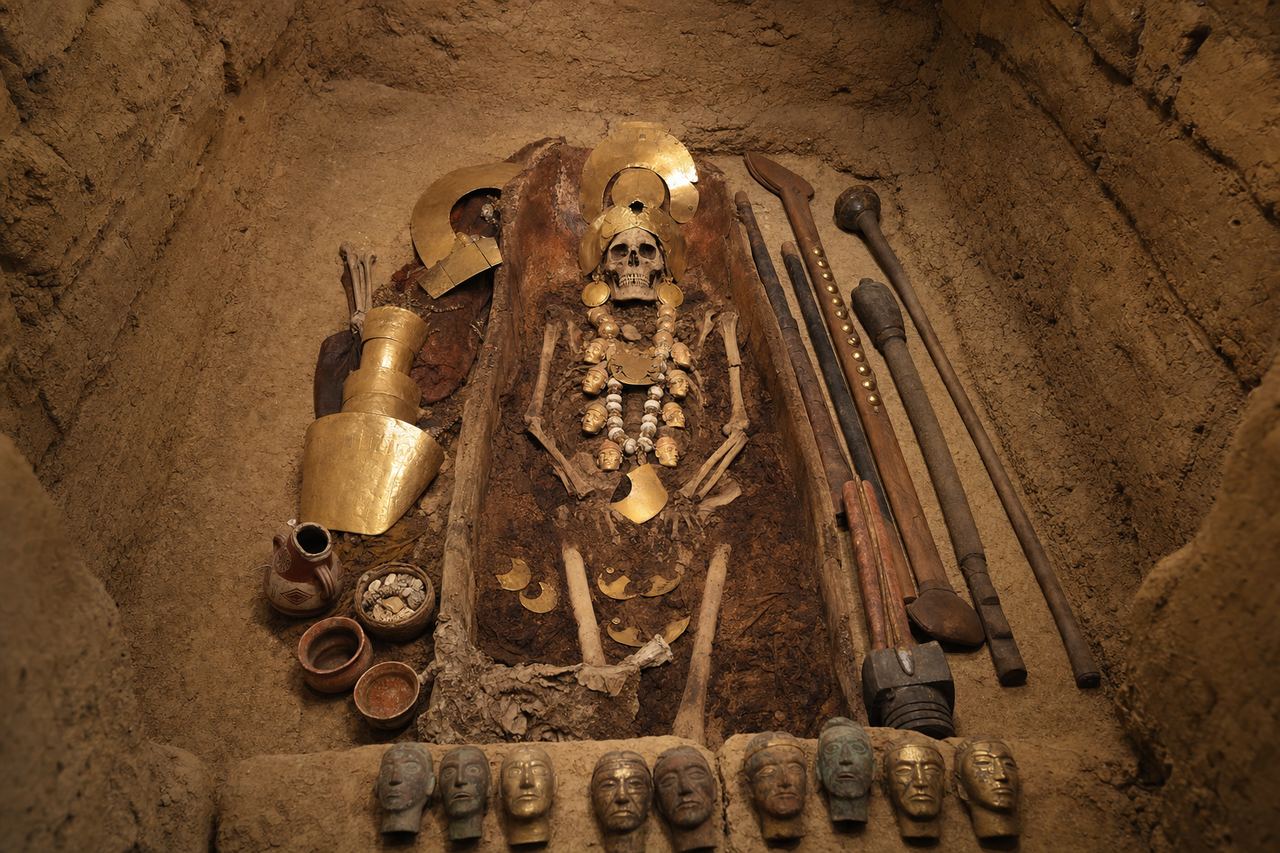
In 2006, archaeologist Régulo Franco Jordán was excavating the Huaca Cao Viejo — a massive mud-brick pyramid built by the Moche civilisation near Trujillo in northern Peru — when his team uncovered a burial chamber unlike anything previously found at a Moche site. The tomb's owner was surrounded by war clubs, spear-throwers, gilded crowns, and the remains of two sacrificed men and a young girl. Everything pointed to a powerful ruler.
But when they examined the skeletal remains in the centre of it all, they found something unexpected: the tomb's owner was a woman.
The Lady of Cao — named after the huaca where she was found — was approximately 20 to 25 years old at her death around 450 CE. She was, according to the evidence in her tomb, a supreme leader of the Moche — a warrior, a priestess, and a ruler at a time when scholars had assumed all such roles were held exclusively by men.
Her Tattoos
What makes the Lady of Cao immediately striking is the tattooing on her arms and legs. The tattoos depict serpents and spiders — supernatural creatures with powerful significance in Moche iconography, creatures associated with fertility, rain, and the boundary between the living and the dead.
The same serpent and spider imagery appears on Moche ceramic art depicting male priests conducting sacrificial rituals. The Lady of Cao was not just a ruler in a political sense — she was a religious authority, conducting the ceremonies that maintained the cosmic order in Moche belief.
"For decades we assumed the Moche Warrior Priest was a man. All the evidence pointed that way — the sacrificial burials, the weapons, the crowns. And then we found her." — Régulo Franco Jordán, lead archaeologist, Huaca Cao Viejo
The Moche and Sacrifice
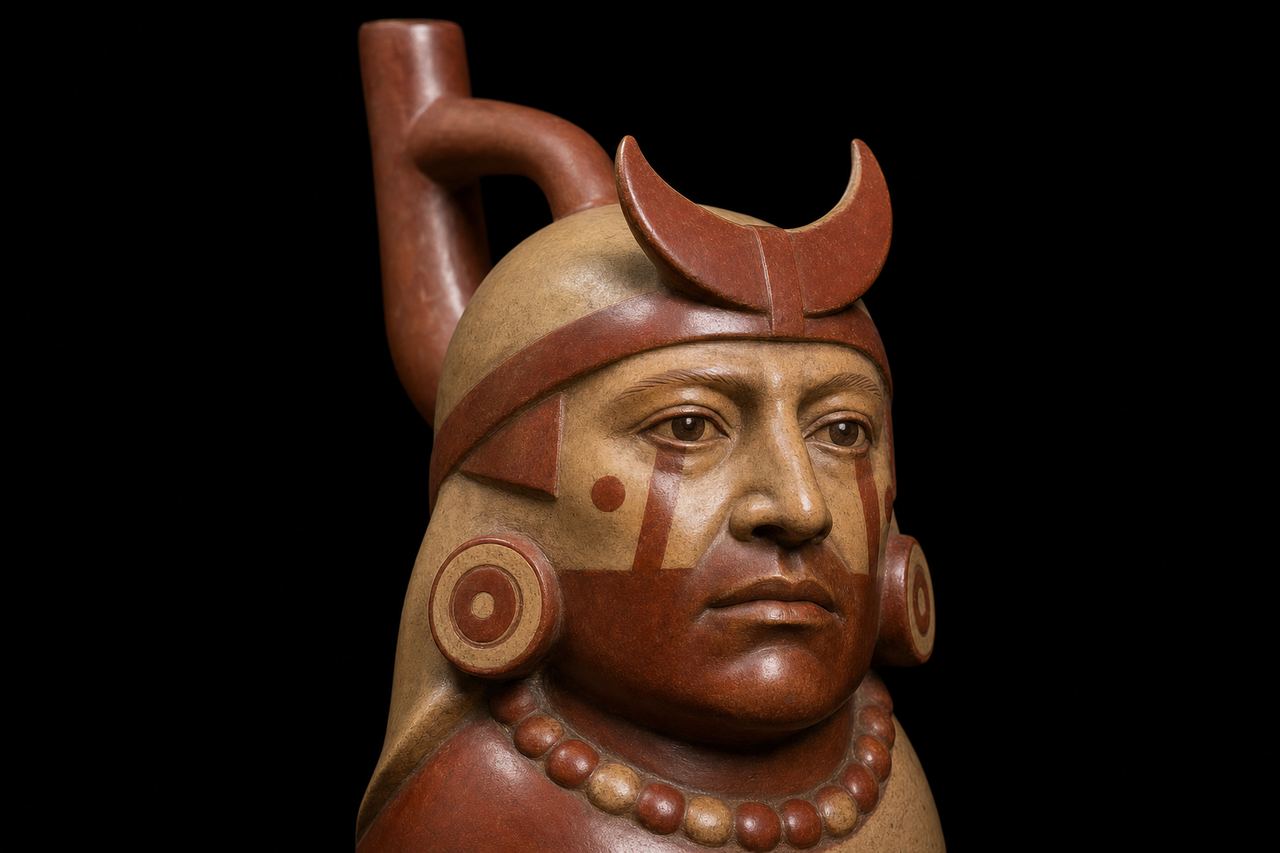
The Moche civilisation flourished along the northern coast of Peru from approximately 100 to 800 CE. They were master craftspeople, engineers, and farmers who built elaborate irrigation systems. They were also a society in which ritual human sacrifice played a central religious role.
Moche ceramic art — some of the most detailed and expressive in the pre-Columbian world — depicts elaborate scenes of combat, prisoner-taking, and the ritual killing of captives, whose blood was offered to the gods. The two men sacrificed and buried with the Lady of Cao were likely captives taken in ritual combat — offered to accompany and serve their ruler in the afterlife.
What Her Tomb Contained
The burial chamber held an extraordinary array of objects. War clubs — the weapons of Moche rulers depicted in ceramic art — lay beside her. Gilded copper crowns. Necklaces of gold, silver, and copper. Dozens of ceramic vessels. The bodies of two sacrificed men, bound with rope, placed at her feet. A young girl, probably a servant, sacrificed to accompany her mistress.
The war clubs are particularly significant: in Moche iconography, they are the weapons held by the supreme ruler in scenes of ritual combat and sacrifice. They are not the objects of a woman buried in a male-dominated world who happened to be placed near weapons. They are the symbols of her power, deliberately and carefully arranged around her body.
Rewriting Moche History
Before the Lady of Cao's discovery, the "Moche Warrior Priest" — a figure depicted throughout Moche art conducting sacrifices and leading ceremonies — was assumed to be male. Several male warrior-priest burials had been found. The Lady of Cao demonstrated that women could hold this supreme religious and political role.
Since 2006, at least one other possible female Moche ruler burial has been identified. The Lady of Cao is no longer an anomaly — she is a door opened onto a more complex understanding of Moche society, gender, and power.
Where She Is Today
The Lady of Cao is the centrepiece of the Cao Museum, opened in 2009 at the Huaca Cao Viejo site near Chocope, La Libertad, Peru. The museum is built into the archaeological site itself, and visitors can see the original burial chamber, the objects found within it, and a facial reconstruction of the Lady herself — created using forensic facial reconstruction techniques applied to her skull.
She has become a powerful symbol in Peru — particularly for Peruvian women — of female leadership in the ancient world. Her image appears on murals, on public art, and in school curricula as evidence that powerful women are not a modern invention but an ancient reality.
Frequently Asked Questions
Who was the Lady of Cao?
The Lady of Cao was a Moche noblewoman who died around 450 CE and was buried in an elaborate tomb at Huaca Cao Viejo on Peru's northern coast. Discovered in 2006 by archaeologist Régulo Franco Jordán, she is the first confirmed female ruler found in Moche culture. She died in her mid-twenties and was interred with war clubs, spear throwers, copper crowns, necklaces of human trophy heads, and more than 200 metal objects — an assemblage previously believed to belong exclusively to male warriors.
Why is the Lady of Cao significant for our understanding of Moche society?
Before her discovery, the Moche civilisation was considered a rigidly male-dominated warrior society — images of war, sacrifice, and rulership in Moche art showed only male figures. The Lady of Cao upended this assumption entirely. Her burial goods match or exceed those of male Moche lords, and two young women were sacrificed and interred with her, indicating the same treatment given to male rulers. She has reshaped the archaeology of Pre-Columbian civilisations in the Americas.
How was the Lady of Cao mummified?
The Lady of Cao was not deliberately mummified but was naturally preserved by the extreme aridity of the Peruvian coastal desert — one of the driest environments on Earth. The lack of moisture prevented bacterial decomposition, desiccating soft tissue over centuries. Her body was wrapped in multiple layers of cotton textiles before burial, which further protected the remains. The preservation allowed bioarchaeologists to determine her approximate age at death, reproductive history, and health.
Where can the Lady of Cao be seen today?
The Lady of Cao is housed and displayed at the Cao Museum (Museo de Cao), built adjacent to the Huaca Cao Viejo archaeological site in the Chicama Valley near Trujillo, Peru. The museum opened in 2009 and presents her mummy alongside her burial goods in a dedicated exhibition. The site is part of the Moche Route, a cluster of pre-Columbian archaeological sites on Peru's northern coast.
What weapons were buried with the Lady of Cao, and why are they significant?
The Lady of Cao was buried with war clubs, spear throwers, and approximately 200 metal objects — an arsenal previously assumed to belong exclusively to male warriors in Moche society. The presence of these items in a woman's tomb fundamentally challenged the long-held assumption that military and political power in Moche culture was reserved for men, establishing her as a figure of genuine authority rather than a ceremonial consort.
Where was the Lady of Cao discovered, and when?
She was discovered in 2006 at Huaca Cao Viejo, an ancient Moche ceremonial complex located in the Chicama Valley on the northern coast of Peru. The site is part of the El Brujo Archaeological Complex. Her remains and burial goods are now housed and displayed at the Cao Museum, built on-site to preserve and present the findings.
How old was the Lady of Cao when she died, and what era did she live in?
She died at approximately 25 to 30 years of age, around 450 CE, during the height of the Moche civilization. Despite her relatively young age at death, the richness of her burial — rivaling those of the most prominent male Moche lords found at other sites — indicates she had already achieved the highest level of political or religious power.
Why is the Lady of Cao considered a turning point in the understanding of Moche society?
Her discovery made her the first confirmed female ruler identified within Moche culture, overturning decades of scholarly consensus that Moche political and military leadership was exclusively male. The two sacrificed young women found with her follow the same funerary patterns seen in high-status male Moche burials, reinforcing that she held equivalent rank and received equivalent ceremonial treatment in death.