Found on the Summit
On 8 September 1995, anthropologist Johan Reinhard and his climbing partner spotted a red feathered headdress on the ice below the summit of Mount Ampato — and beneath it, a bundle containing a young girl, frozen for over 500 years. Juanita is one of the best-preserved humans ever discovered.
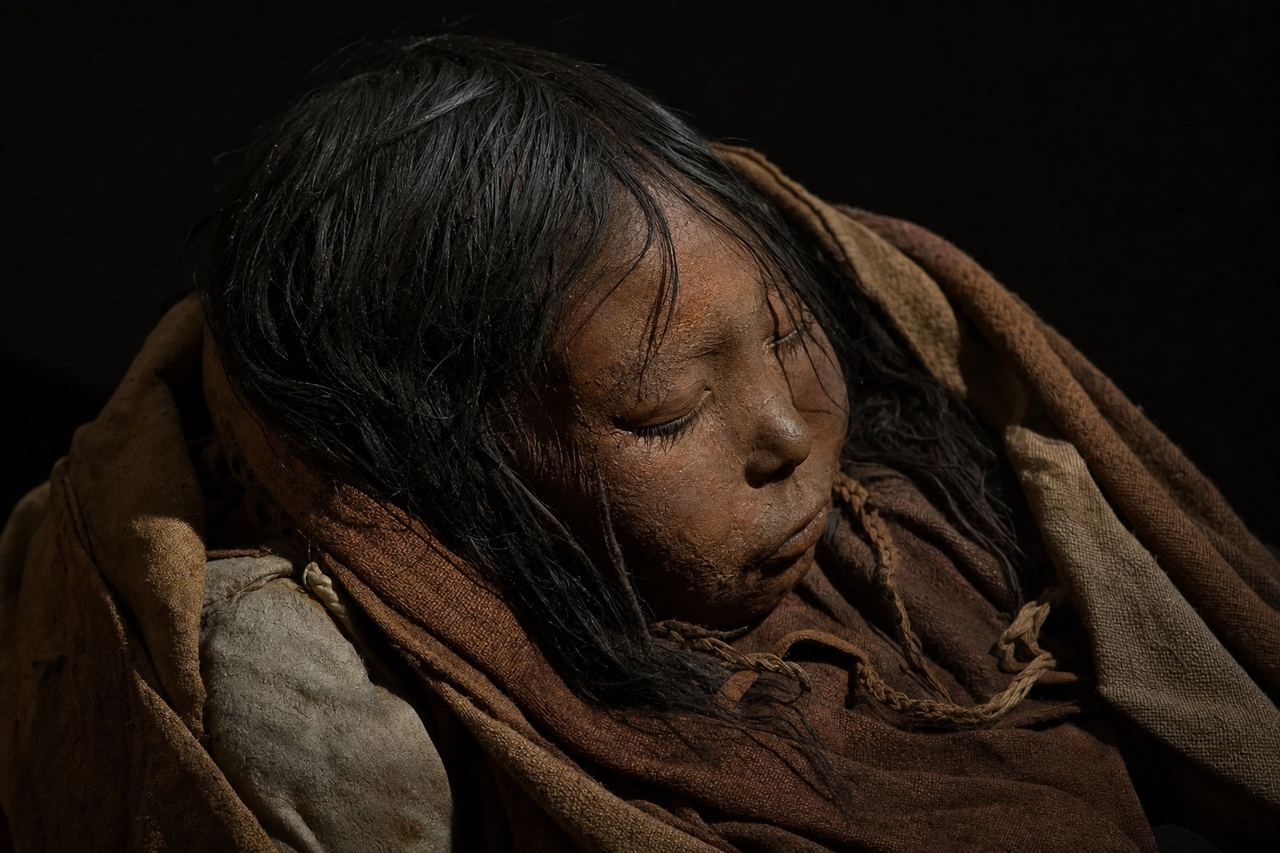
Her Life
Isotope analysis of her hair reveals she was selected for capacocha ritual approximately one year before her death. Her diet changed dramatically — she began eating elite foods available only to Inca nobility. She was between 12 and 14 years old and likely from a noble family. She may have walked hundreds of kilometres to Cusco to meet the Sapa Inca himself.
The Sacrifice
She was killed by a single massive blow to the right side of the skull. She may have been sedated with chicha (maize beer). She was placed in a seated position on the summit, wrapped in textiles, and left to freeze. Her blood vessels still contained intact blood cells when she was examined.
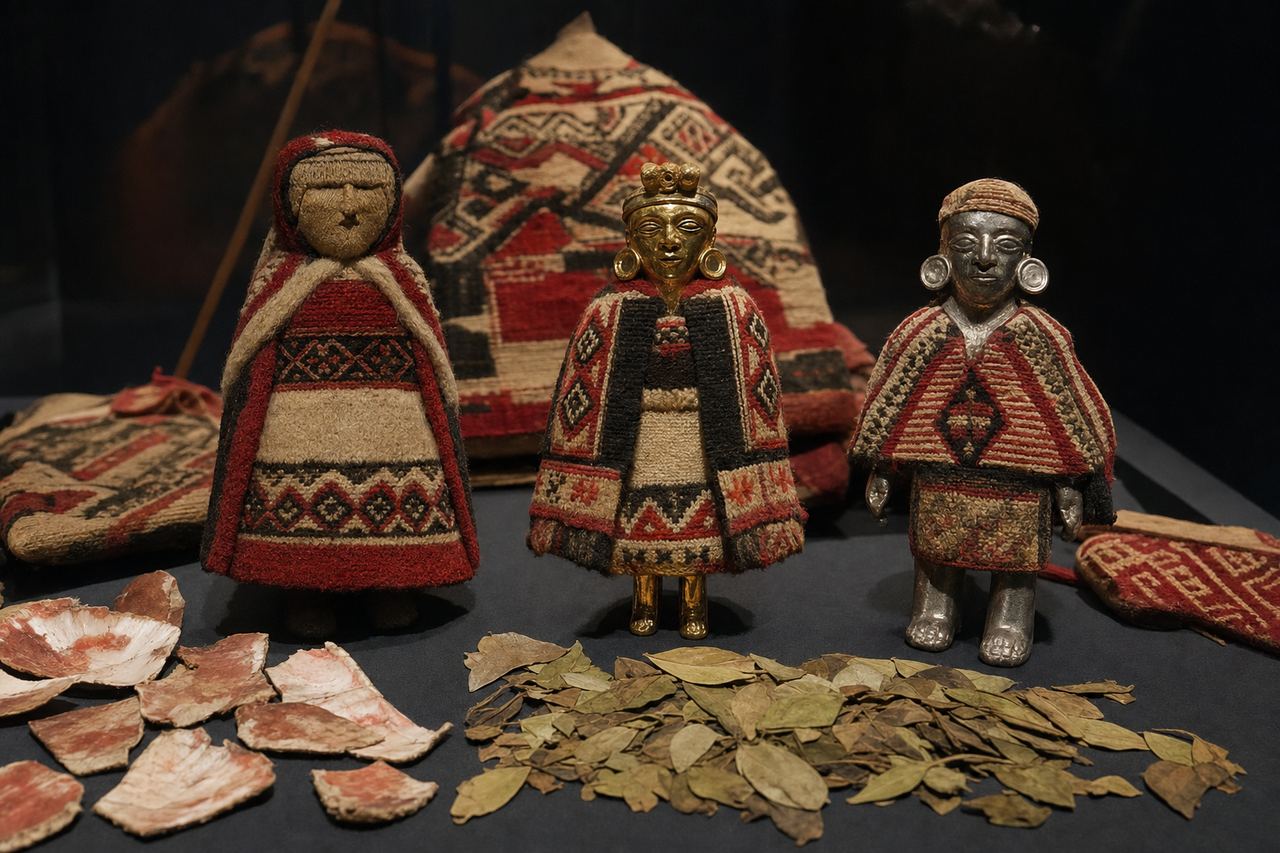
"We were looking at a person who had been alive less than 500 years ago."— Johan Reinhard, 1995
The Eruption That Revealed Her
Juanita lay undisturbed for roughly 550 years beneath the ice of Ampato's summit — until geology intervened. Sabancaya, a neighbouring Andean volcano, began an eruptive cycle that deposited layers of dark ash across Ampato's snowfield. Dark surfaces absorb solar radiation more efficiently than white ice, and the accelerated melting destabilised the ancient burial platform. Juanita's wrapped bundle rolled partway down the slope and came to rest on a lower ridge. On 8 September 1995, Johan Reinhard and his climbing partner Miguel Zárate spotted her red feathered headdress protruding from the ice and began to excavate. Without that specific eruption at that specific time, she would almost certainly remain undiscovered beneath the summit today.
What the CT Scans Showed
Once Juanita was transported to the United States for analysis — first stored in a freezer at the University of Michigan, then examined at Johns Hopkins Hospital — CT scanning revealed the cause of death in detail. The right side of her skull showed a massive fracture consistent with a single blow from a blunt weapon, most likely a star-shaped club of the type associated with Inca ritual use. The impact shattered the cranium and caused extensive internal hemorrhaging. Blood had pooled and frozen within the skull. There were no defensive injuries anywhere on the body. She had not struggled. The absence of any sign of resistance strongly supports the conclusion that she was unconscious — almost certainly sedated with chicha — before the blow was delivered.
The state of her soft tissue was remarkable. Her internal organs remained intact. When researchers examined her blood, they found intact red blood cells — a preservation so complete that it placed her among the best-preserved biological specimens of any human being from the pre-Columbian era. The frozen conditions at Ampato's summit had functioned as a natural cryogenic chamber, arresting cellular degradation at the moment of death.
Her Journey and Display History
Reinhard carried Juanita down the volcano in his backpack — a logistical reality of high-altitude archaeology that underscores how improvised the recovery was. She was initially stored in a local freezer in Arequipa before being transported to the United States. In 1996, she was displayed at the National Geographic Society in Washington DC, where she was viewed by tens of thousands of visitors, including Peruvian President Alberto Fujimori, who reportedly stood in silence before her for an extended period. She returned to Peru and is now permanently housed at the Museo Santuarios Andinos of the Catholic University of Santa María in Arequipa — displayed in a sealed, refrigerated chamber maintained at −20°C. She is exhibited to the public for most of the year, with periodic closures for maintenance of the display system.
Frequently Asked Questions
Where is Juanita the Ice Maiden now?
Juanita is permanently housed at the Museo Santuarios Andinos of the Catholic University of Santa María in Arequipa, Peru. She is displayed in a sealed refrigerated chamber maintained at −20°C. The museum was established specifically to house her and the other offerings recovered from the Ampato summit. She is on public display for most of the year.
How did archaeologists find Juanita?
A volcanic eruption from nearby Sabancaya deposited ash on Ampato's summit, accelerating snowmelt and destabilising her burial platform. Her wrapped bundle rolled partway down the slope. On 8 September 1995, Johan Reinhard and his climbing partner Miguel Zárate spotted her red feathered headdress in the ice and recovered her. Without that specific eruption, she would almost certainly still be buried beneath the summit.
How did Juanita die?
CT scans revealed a massive fracture to the right side of her skull from a single blunt blow, almost certainly from a ritual club. The impact caused extensive hemorrhaging and likely killed her instantly or within seconds. She showed no defensive injuries, indicating she was unconscious — likely heavily sedated with chicha — when the blow was delivered. Her blood remained intact and frozen inside the skull at the time of discovery.
How old was Juanita when she was sacrificed?
Juanita was between 13 and 14 years old at the time of her sacrifice, around 1450 CE. Bone density and growth plate analysis confirmed she had not reached full skeletal maturity. Isotope analysis of her hair shows she was selected for the Capacocha ceremony approximately one year before her death, during which time she consumed an elite diet and may have walked to Cusco to be presented to the Sapa Inca himself.