The Day It Happened
At approximately 1pm on 24 August 79 CE, Mount Vesuvius erupted with a force 100,000 times that of the Hiroshima bomb. A column of volcanic material rose 33 kilometres into the sky — a Plinian eruption, named after the man who described it: Pliny the Younger, watching from Misenum across the Bay of Naples.
The Two Phases
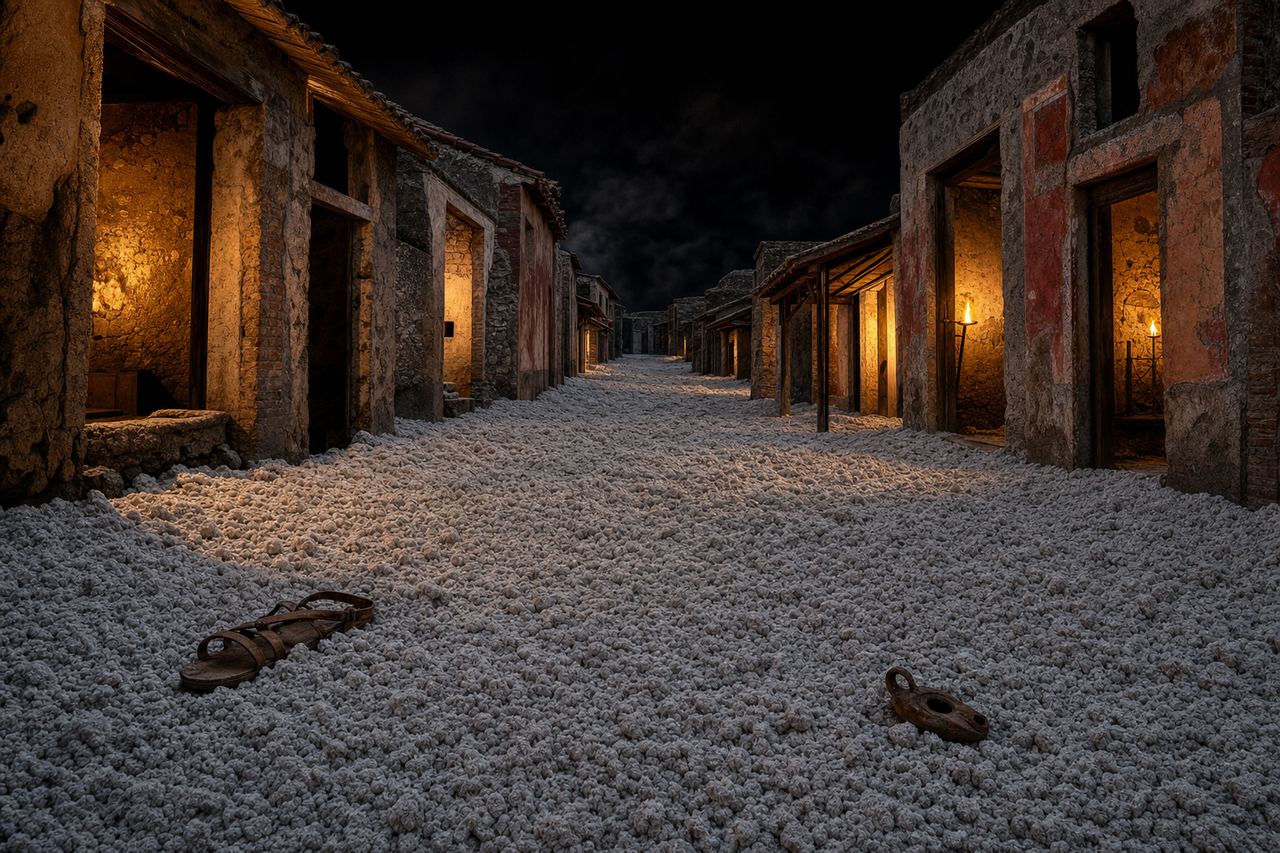
Phase 1 (afternoon through night): Pumice and ash fell on Pompeii at a rate of 15 centimetres per hour. Some people fled; many sheltered indoors, thinking the worst had passed. By midnight, the roofs of Pompeii were beginning to collapse under the weight.
Phase 2 (early morning): A series of pyroclastic surges swept down the mountain. The first surge reached Herculaneum at approximately 1am, killing everyone in the city instantly. Later surges reached Pompeii — killing those who had survived the night, burying the city under six metres of volcanic material.
"Darkness fell, not the dark of a moonless or cloudy night, but as if the lamp had been put out in a closed room."— Pliny the Younger, Letters, Book VI, 79 CE
The Aftermath
An estimated 16,000 people died in the eruption — though the true number is unknown. Pompeii was rediscovered accidentally by well-diggers in 1748. Herculaneum had been found even earlier, in 1709. Both cities are still being excavated. New discoveries are made every year.
The Sequence of Events
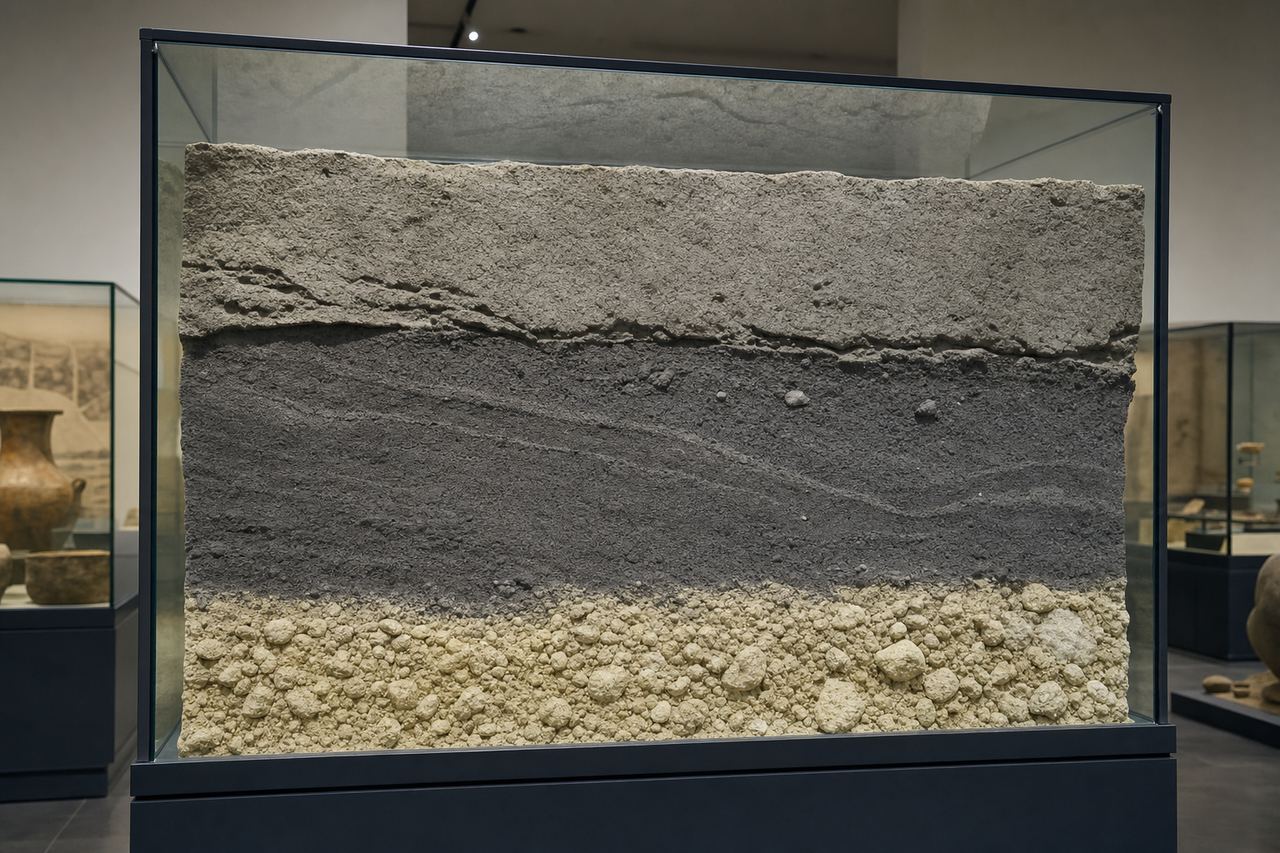
The eruption unfolded in a precise sequence now reconstructed from stratigraphy, the Pliny letters, and isotope analysis of the deposits. At approximately 1pm, the eruption column punched through the summit and began rising — eventually reaching 33 kilometres, well into the stratosphere. For the next several hours, pumice and ash rained down on Pompeii at a rate of 15 centimetres per hour. Roofs began collapsing under the weight by midnight. People who had stayed indoors were increasingly trapped; people who had fled early were, in many cases, safe. The Roman writer Pliny the Younger, watching from Misenum 30 kilometres away, described the darkness that descended over the bay as total — not night darkness but the darkness of a sealed room.
At approximately 1am, the eruption column destabilised and partially collapsed. The collapse sent the first of six pyroclastic surges — dense, superheated avalanches of gas, ash, and rock — down the volcano's flanks. The first surge reached Herculaneum and killed its remaining population instantly. Surges continued at intervals through the early morning. The fifth and sixth surges were large enough to reach Pompeii, overwhelming those who had survived the pumice fall. By dawn, both cities were gone. The sixth surge deposited a final layer of ash that sealed everything beneath it for seventeen centuries.
The Date Debate
For two centuries, the eruption was dated to 24 August 79 CE — the date derived from Pliny the Younger's letters, in which he referred to the eruption occurring "the ninth day before the Kalends of September." That calculation resolves to 24 August. But the manuscripts of Pliny's letters exist in multiple versions, and the date varies between them — some render it as the ninth day, some as the eleventh. The August date was treated as established because it was consistent with the archaeological evidence as understood at the time.
In 2018, excavators working in the Regio V section of Pompeii found a charcoal inscription on a wall — a note that appears to have been written as a casual calendar reminder — dated to "the sixteenth day before the Kalends of November," which resolves to 17 October. The inscription was still fresh charcoal, not faded, suggesting it had been written not long before the eruption. This is supported by additional evidence: the eruption ruins contain ripe pomegranates, braziers being used for heating, and winter-weight woollen clothing on several of the victims. None of these are typical of late August. The October date now commands serious support among volcanologists and classical archaeologists, though it has not yet been universally adopted.
Pliny the Elder — The Man Who Went Toward It
The only person known to have sailed toward Vesuvius as it erupted was Pliny the Elder — scholar, naval commander, and author of the encyclopaedic Natural History. When the eruption began, he was at the Roman fleet's base at Misenum. He initially moved to observe it scientifically. Then a rescue request arrived from a woman on the shore near Stabiae whose house was cut off by the pumice fall. He redirected his fleet and attempted a landing.
His nephew's account describes what followed: the fleet could not land at Pompeii because the sea had receded and the shore was blocked by debris. Pliny made it to Stabiae, where he stayed with a friend named Pomponianus. That night, he slept — either from exhaustion or as a deliberate act of calm — while those around him were in panic. The next morning, the group attempted to flee. Pliny was unable to stand. He collapsed on the beach and died. The cause of death was almost certainly cardiac failure, possibly combined with asphyxiation from sulfurous fumes. He was 56 years old. His body was recovered three days later, his nephew writes, apparently unharmed — no burns, no crush injuries — as though he had simply lain down and stopped.
Frequently Asked Questions
When did the eruption of Vesuvius destroy Pompeii?
The traditional date is 24 August 79 CE, based on Pliny the Younger's letters. However, a charcoal inscription found in Pompeii in 2018, dated to mid-October, and physical evidence including winter clothing and ripe pomegranates in the ruins, suggests the eruption may have occurred on 24 October 79 CE. The debate among scholars is ongoing.
How long did the eruption last?
The eruption lasted approximately 18 to 19 hours. The first phase — a Plinian column of gas, ash, and pumice rising 33 kilometres — dominated the afternoon and night. The second phase, a series of six pyroclastic surges sweeping down the volcano's flanks, began in the early morning hours. The first surge reached Herculaneum around 1am; later surges hit Pompeii and killed those who had survived the night.
How many people died at Pompeii?
Approximately 2,000 bodies have been found within Pompeii's excavated area. Ancient sources suggest the city had a population of around 11,000 to 20,000 people, meaning the majority likely escaped before the pyroclastic surges arrived. The total death toll across the region — including Herculaneum, Stabiae, Oplontis, and rural areas — is unknown.
Who wrote the only eyewitness account of the eruption?
Pliny the Younger wrote two letters to the historian Tacitus describing what he witnessed from Misenum. His uncle Pliny the Elder sailed toward the eruption to rescue survivors and died on the shore at Stabiae — likely from cardiac failure or sulfurous fumes. These letters are the only contemporary written account of the disaster.