A Different Fate
While Pompeii was slowly buried under falling pumice over 18 hours, Herculaneum — Pompeii's wealthy smaller neighbour, sitting directly at the foot of Vesuvius — was hit by a pyroclastic surge. A superheated cloud of volcanic gas and rock travelling at up to 100 kilometres per hour, at temperatures between 300°C and 500°C, reached Herculaneum in the early hours of 25 August 79 CE. Death was instantaneous.
The Boat Sheds
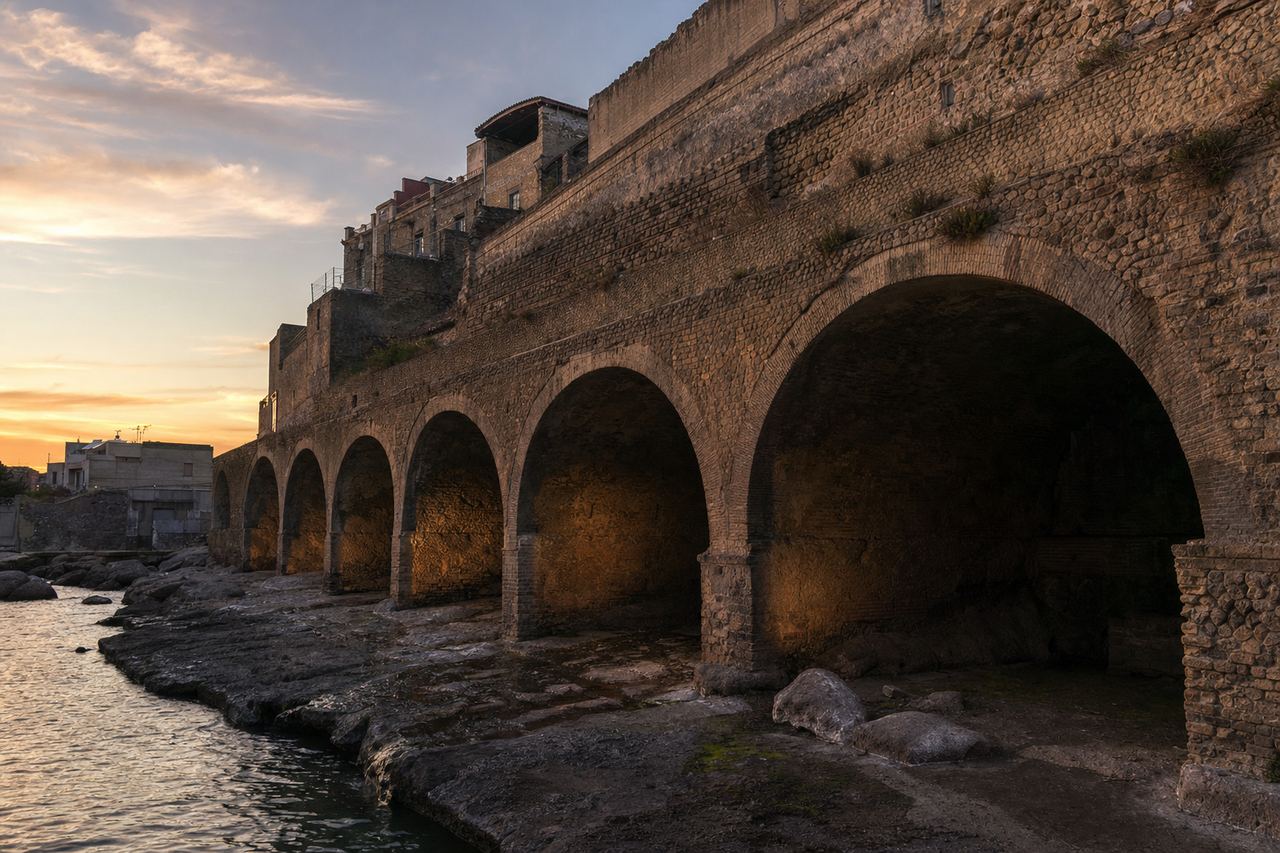
As the eruption began, approximately 300 people gathered in the stone boat sheds along Herculaneum's beach, hoping to escape by sea. No boats came. The pyroclastic surge reached them before rescue arrived. Their skeletal remains — still in the positions they died in, still showing people sheltering, embracing, shielding themselves — were discovered in the 1980s.
The heat was so intense that some skulls exploded from the pressure of rapidly vaporising brain tissue. Researchers found skull fragments projected against the walls of the sheds.
What Was Preserved
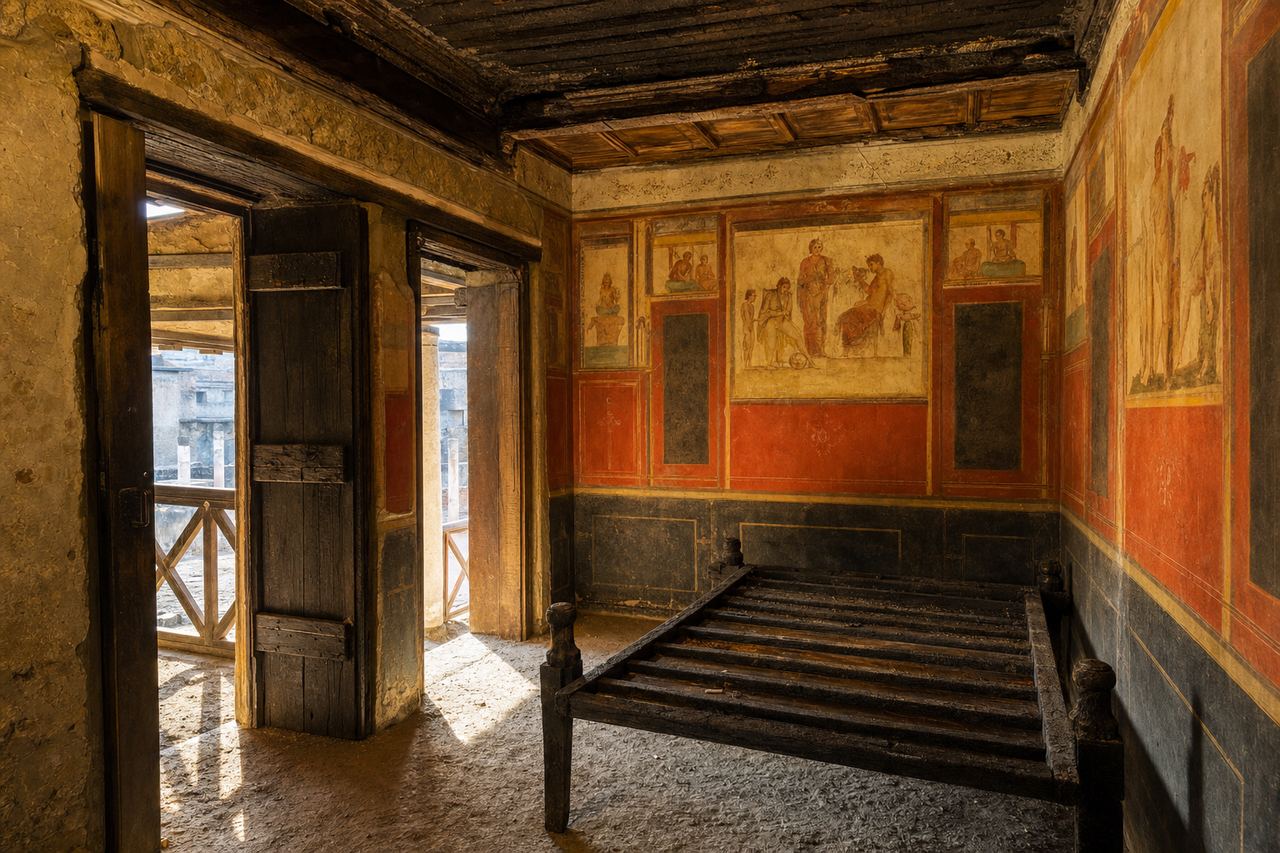
The extreme heat actually preserved things that Pompeii's slower burial destroyed. Organic materials were carbonised rather than decayed. The Villa of the Papyri contained over 1,800 papyrus scrolls — the only intact ancient library ever found. New technology is still unrolling and reading them today, recovering lost texts from ancient philosophers.
The Boat Arches — Who They Were
The discovery of the boat-arch skeletons in the early 1980s transformed understanding of what happened on the Herculaneum waterfront. Excavators found the remains of approximately 300 people crammed into the low stone arches — not in flight, but waiting. They had reached the beach and stopped, presumably watching the sea for vessels. The boats did not come in time.
DNA and isotope analysis conducted in subsequent decades has revealed that these were not a homogeneous local population. The genetic profiles of the skeletal remains show individuals originating from across the Roman Empire — North Africa, the eastern Mediterranean, central Europe. Herculaneum in 79 CE was a cosmopolitan town at the edge of one of the most active harbours in the ancient world. The people who died on that beach had come from many different places. Some of the skulls shattered — the heat of the pyroclastic surge was sufficient to vaporise moisture inside the cranium, exploding the bone outward. Fragments were found embedded in the walls of the arches.
Vitrified Brains and the Physics of Death
In 2020, researchers studying the skeleton of a man found in the Herculaneum collegium — a building near the forum — made an extraordinary discovery. Inside his skull was a glassy black material: his brain had vitrified. The extreme heat of the pyroclastic surge, reaching 500°C in some estimates, had caused his brain tissue to rapidly convert to glass before it could burn or decompose. This is a process — vitrification by rapid heating — never previously documented in a human remain. It requires precise conditions: fast enough heating to prevent combustion, but intense enough to convert biological tissue into an amorphous solid.
The same remains showed evidence of red and black residue on the pillow he had been lying on — possibly carbonised scalp and hair. The man appears to have been asleep when the surge arrived. For him, as for everyone in Herculaneum that night, death came without warning and without the possibility of response.
The Scrolls — Reading the Unreadable
When the Villa of the Papyri was partially excavated in the 18th century, its 1,800 papyrus scrolls were so thoroughly carbonised that attempts to unroll them physically destroyed most of what was touched. For two centuries they sat, mostly unread — black, brittle tubes of charred organic material. The only ancient library to survive from antiquity was illegible.
That changed with the development of multispectral imaging and, more recently, with the Vesuvius Challenge — a project that applied machine learning models trained on the ink patterns visible in micro-CT scans of the scroll interiors. In 2023 and 2024, substantial passages of text were recovered and read for the first time in two thousand years. Recovered works include treatises by the Epicurean philosopher Philodemus on music, rhetoric, and the nature of pleasure. Scholars believe that further excavation of the villa — much of which remains underground — could yield hundreds more scrolls, possibly including texts from Aristotle, Sophocles, or Livy known only by title from ancient references.
Frequently Asked Questions
What is the difference between Herculaneum and Pompeii?
Herculaneum was a smaller, wealthier Roman city located about 7 kilometres from Vesuvius — closer than Pompeii. While Pompeii was buried slowly under metres of falling pumice and ash over many hours, Herculaneum was obliterated instantly by a superheated pyroclastic surge. This difference in burial mechanism created very different preservation conditions: Pompeii preserved soft ash voids around bodies, while Herculaneum carbonised organic materials and baked skeletons into the rock.
Why were Herculaneum bodies preserved differently?
The pyroclastic surge that hit Herculaneum reached temperatures of 300–500°C and moved at roughly 100 kilometres per hour. At those temperatures, soft tissue was instantly vaporised, leaving only bones. However, the extreme heat also vitrified — turned to glass — the brains of some individuals, a phenomenon documented for the first time at Herculaneum and never previously observed in any other archaeological context.
What happened to the people who fled to the beach?
Approximately 300 people gathered in the stone boat-storage arches along Herculaneum's ancient shoreline, waiting for rescue by sea. When the pyroclastic surge struck in the early hours of 25 August 79 CE, they died instantly where they sat and crouched. Their skeletons were discovered in the 1980s, still in the positions of their final moments. DNA analysis has shown they came from diverse regions across the Roman Empire.
What are the Herculaneum scrolls?
The Villa of the Papyri at Herculaneum contained approximately 1,800 papyrus scrolls, the only intact library to survive from antiquity. The pyroclastic surge carbonised them into fragile black tubes. Since 2019, multispectral imaging and AI-assisted analysis have begun recovering text from within the sealed rolls, recovering works by Epicurean philosophers lost for two thousand years.