A Thriving Roman City
It is easy to think of Pompeii as a place defined by its destruction. But for roughly 700 years before the eruption — from its founding in the 6th century BCE to 79 CE — Pompeii was simply a city. A prosperous, noisy, complicated Roman city of approximately 11,000–20,000 people, sitting on a volcanic plateau above the Bay of Naples, 10 kilometres from Vesuvius.
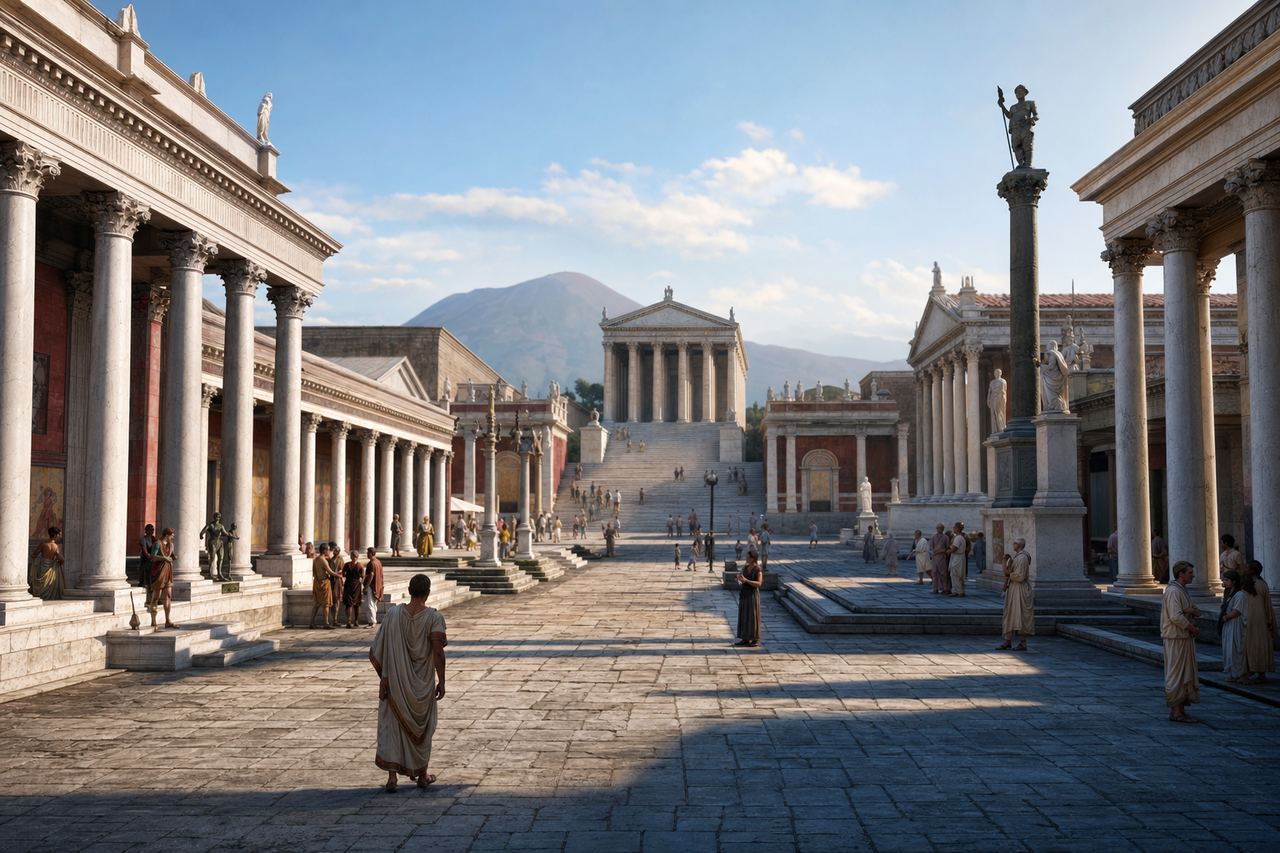
Before 79 CE, Vesuvius was not feared. It had not erupted in recorded history. The Romans knew it as a mountain, not a volcano — forested, scenic, good for vineyards. The soil around it, enriched by ancient eruptions, was among the most fertile in Italy. The towns in its shadow were wealthy.
The Streets
Pompeii's streets were paved with large basalt blocks, worn smooth by centuries of cart traffic. Deep grooves cut by iron-rimmed wheels are still visible in the stone. Stepping stones allowed pedestrians to cross the streets — which doubled as open sewers — without getting their feet wet. The city was busy, crowded, and loud.
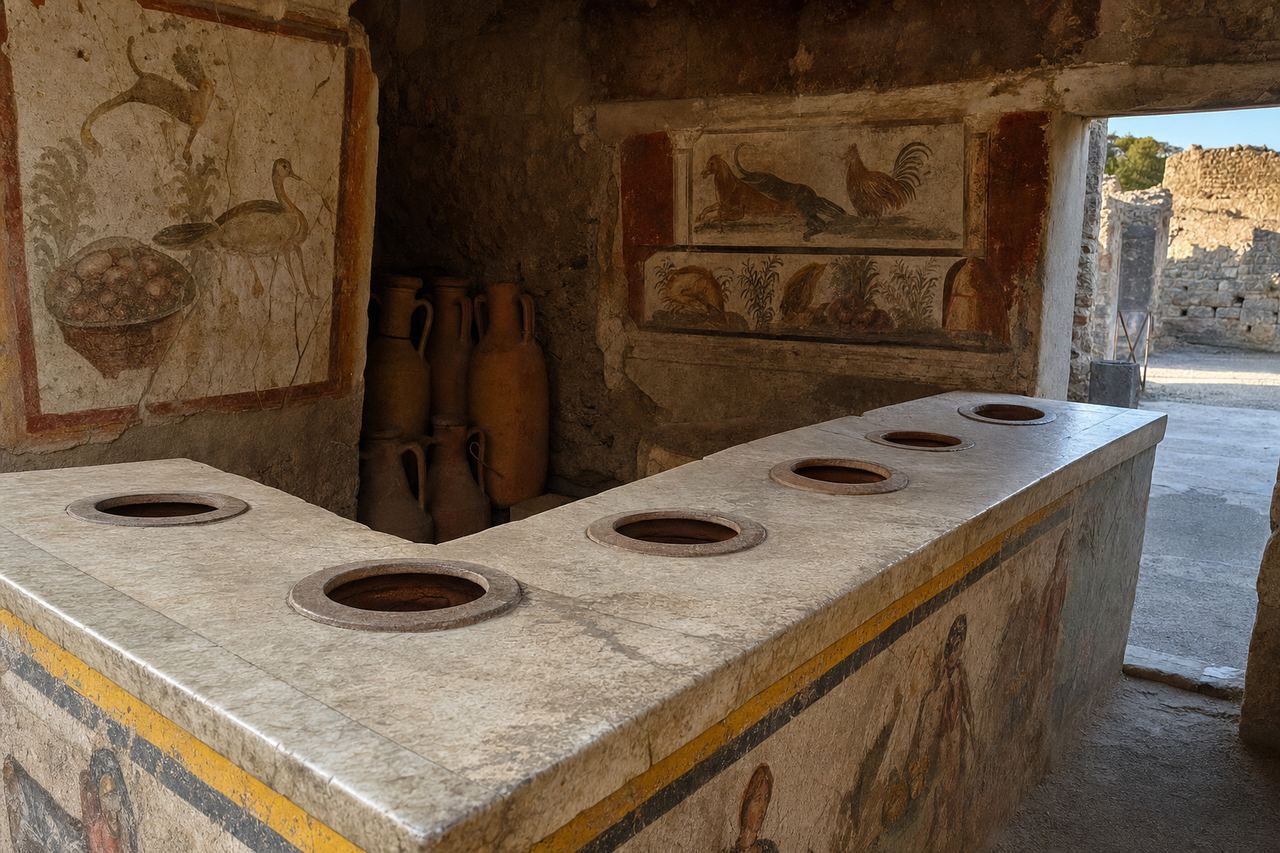
Thermopolia — the Roman equivalent of fast-food counters — lined the streets. At least 80 have been found in Pompeii. They had stone counters with large ceramic vessels sunk into them, containing hot food and drink. The remains of food found in these vessels include lentils, salted fish, fava beans, wine, and olive oil. Most Pompeians did not cook at home; they ate at these counters multiple times a day.
The Graffiti
The walls of Pompeii are covered in graffiti — over 11,000 inscriptions have been catalogued, making Pompeii the single richest source of everyday Latin writing from the ancient world. The inscriptions range from the literary (quotes from Virgil's Aeneid) to the electoral (candidates for municipal office had professional sign-painters create elaborate endorsements) to the frankly obscene.
Some of the most charming are personal: "Romula loves Staphylus." "I wonder, wall, that you have not yet fallen in ruins, when you have to bear the stupidities of so many writers." "On 3 July, I made bread." Election slogans reveal the texture of Roman democracy: "The muleteers ask you to elect Gaius Julius Polybius as aedile." "The petty thieves support Vatia for aedile." (Whether this was satirical or genuine endorsement is unclear.)
"The real Pompeii is not the silent ruin you visit. It was full of arguments, laughter, smells, noise, and people who had absolutely no idea that their city would still exist two thousand years later."— Mary Beard, classicist, Pompeii: The Life of a Roman Town
The 62 CE Earthquake
Pompeii's last seventeen years were shaped by a massive earthquake that struck in 62 CE — just 17 years before the eruption. The earthquake caused widespread damage throughout the city, and in 79 CE, much of Pompeii was still under reconstruction. Some of the most valuable finds in Pompeii have been discovered in the context of repair work: buildings still scaffolded, piles of building materials in streets, walls only partially replastered.
The earthquake of 62 CE was almost certainly caused by the same volcanic activity that would eventually culminate in the 79 CE eruption. The Earth was warning Pompeii. Nobody understood the warning.
The Warning Signs in 79 CE
In the days and weeks before the eruption, Pompeii received multiple warning signs that, had they been understood, might have saved thousands of lives. Wells ran dry. Minor earth tremors rattled buildings. Strange gases emerged from the ground, killing animals in low-lying areas. The Roman writer Cassius Dio describes unusual phenomena in the sky.
None of this was recognised as volcanic. Romans had no concept of volcanic activity — the word "volcano" did not exist in Latin. Vesuvius had been dormant for so long that it was not in any way feared. The people of Pompeii had no framework for interpreting what they were experiencing. When the mountain finally exploded at 1pm on 24 August, it was, for most of them, entirely without warning.
Frequently Asked Questions
How did Pompeians get their food and water every day?
Pompeii had over 80 thermopolia — street-side food counters with built-in ceramic jars for storing hot food and drinks — serving residents who lacked their own kitchen facilities. The city's water supply came via a branch of the Aqua Augusta aqueduct, feeding a network of street fountains, public baths, and private homes through lead pipes. This infrastructure made Pompeii one of the best-supplied cities in the Roman world.
What was garum, and why was it so important to Pompeii's economy?
Garum was a pungent fermented fish sauce used as a primary condiment and salt substitute across the Roman world, and Pompeii was a major production hub for it. Factories within the city processed fish scraps in large vats, and the finished product was exported in distinctive ceramic amphorae throughout the empire. The trade made some Pompeian merchants — most famously the Umbricii Scaurii family — extremely wealthy.
Was Pompeii still recovering from damage when Vesuvius erupted?
A severe earthquake in 62 CE, roughly 17 years before the eruption, caused widespread destruction across Pompeii. Archaeological evidence shows that many public buildings, including the Temple of Jupiter in the Forum, were still undergoing repair or reconstruction in 79 CE when Vesuvius erupted. This means the city its residents knew in their final days was, in places, still a construction site.
What is the oldest surviving Roman amphitheatre, and where is it?
The amphitheatre of Pompeii, built around 70 BCE, is the oldest stone amphitheatre known to survive from the Roman world — predating the Colosseum by roughly 140 years. It could seat approximately 20,000 spectators, a capacity that exceeded the city's own estimated population of 11,000 and suggests it drew visitors from the surrounding Campania region. A riot between Pompeians and visitors from Nuceria in 59 CE led the Roman Senate to ban gladiatorial games there for ten years.