Fiorelli's Idea
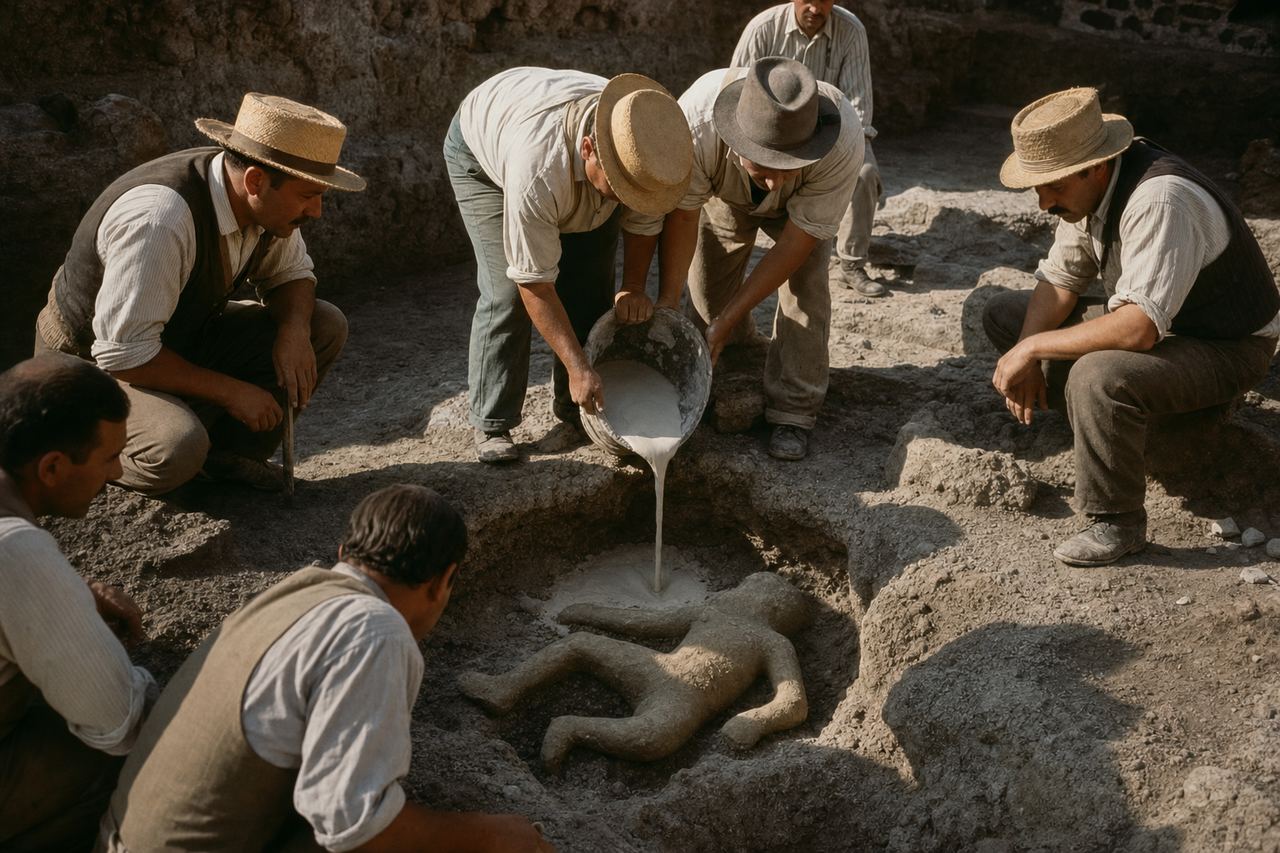
When Pompeii was first excavated in the 18th century, workers kept finding mysterious hollow cavities in the volcanic ash. For a century, the significance went unrecognised. In 1863, archaeologist Giuseppe Fiorelli poured liquid plaster into one of the cavities. When it hardened and he chipped away the surrounding ash, he was looking at a perfect human body — a person at the exact moment of death.
The Casts
Over 1,000 body casts have been made from Pompeii's ash voids. They show: a man in the foetal position, hands over his face; a woman collapsed forward reaching out; a family — three adults and a child — lying together; a dog, back arched, still chained. In 2015, CT scans of a cast known as "the young woman" revealed she had been pregnant — her unborn baby's bones visible inside.
The Garden of the Fugitives
The most devastating display in Pompeii is the Garden of the Fugitives — an open-air enclosure where thirteen body casts lie exactly where they fell. They tried to flee to the south, made it as far as the garden, and died there together. Adults and children. Their faces pressed into the earth. Their postures speak across two millennia.
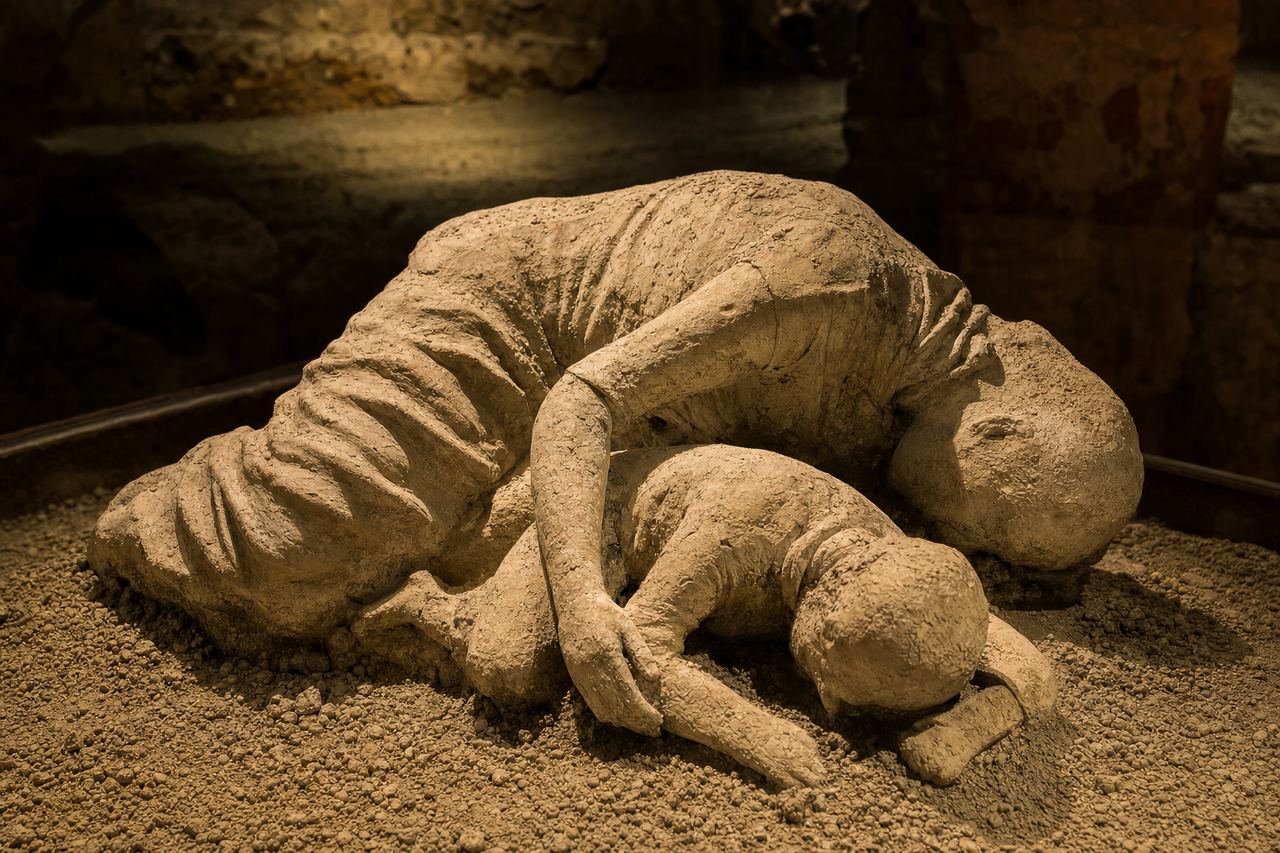
"They are not statues. They are people. That is what makes them unbearable."— Modern visitor, Garden of the Fugitives
How the Technique Works
Fiorelli's insight in 1863 was deceptively simple, and it changed archaeology permanently. The pyroclastic material that buried Pompeii encased bodies in a dense, fine-grained matrix. As organic tissue decomposed over centuries, it left behind hollow cavities — perfect negatives of every person, every animal, every wooden object that had been buried. The ash retained the impression of clothing folds, facial hair, the lines of a clenched hand. Fiorelli had workers drill a small hole into the top of each void and inject liquid plaster under pressure. Once it set — which took about two days — the surrounding ash was carefully chipped away with small tools. What emerged was a three-dimensional record of a human being at the precise moment of death.
The technique was not without limits: the plaster was opaque, so the bones inside could not be studied without destroying the cast. That problem was not solved until the 1980s, when researchers began making new casts with clear synthetic resin instead of plaster. The resin casts allow X-rays and full CT scanning, revealing the skeleton, teeth, and any small objects — coins, rings, amulets — that the victim was carrying. Old plaster casts have also been scanned by placing detectors against the exterior. In one case, a plaster cast made in the 19th century was found to contain the bones of a woman who had been pregnant — her unborn child's skeleton visible for the first time on the CT image.
Notable Individuals
Among the more than 1,000 casts made at Pompeii, several have attracted sustained attention. The Chained Dog is among the most striking: a large dog, still wearing its collar, back arched upward, apparently trying to climb a wall as the ash fell — the chain held it in place. It was found in the House of Orpheus. A pregnant woman, discovered in 2015 using CT scanning of an existing cast, showed fetal bones inside the mother's pelvic region — one of the most quietly devastating discoveries the casts have produced. A man identified from his clothing as a slave — wearing a simple tunic, not the toga of a citizen — was found near the entrance of a house, apparently trying to force open a door that had been blocked by fallen debris from inside.
What gives the casts their power is precisely the involuntary nature of the record. Fiorelli's plaster captured not what the people wanted to show, but what they were doing: protecting their faces, reaching for someone beside them, collapsing forward. The casts are not portraits. They are crime scene evidence from the worst day in one city's history, preserved by the very catastrophe that ended it.
The Ethics of Display
As scholarly understanding of the casts has deepened, so has the ethical debate surrounding them. The casts are human remains — not representations, not models, but the actual shapes of specific people who died without consenting to be displayed in perpetuity. Several Italian anthropologists have argued that at minimum, the individuals should be identified as fully as possible before being exhibited, and that exhibiting body casts in outdoor enclosures without contextual explanation reduces the dead to spectacle. A minority position, advanced by scholars with ties to the modern Neapolitan community — which is genetically continuous with the ancient Campanian population — argues that the casts should eventually be reburied, as any other human remains would be. The Pompeii Archaeological Park has not moved toward reburial, but the conversation has led to improved interpretive signage and more careful framing of what visitors are actually looking at.
Frequently Asked Questions
How were the Pompeii body casts made?
When the pyroclastic surge buried Pompeii, it entombed the bodies of the dead in layers of volcanic ash and pumice. Over centuries, the organic matter decomposed, leaving hollow cavities in the exact shape of each person. In 1863, archaeologist Giuseppe Fiorelli realised he could fill these voids by injecting liquid plaster under pressure. Once set, the surrounding ash was carefully removed to reveal a precise cast of the body — including clothing folds, facial expressions, and the texture of hair.
How many body casts exist at Pompeii?
Over 1,000 body casts have been made at Pompeii since Fiorelli's technique was introduced in 1863. Not every cavity discovered has been cast — some are left in place for future study, as technology for analysing them continues to improve. The largest group — thirteen individuals — is displayed together in the Garden of the Fugitives.
What do the body casts show?
The casts capture the precise physical state of each victim at the moment of death: posture, position of limbs, clothing, and in many cases facial expression. Since the 1980s, resin has replaced plaster for new casts, and CT scanning of both old and new casts has revealed bones, teeth, jewellery, and coins inside — providing both the external form and skeletal information simultaneously.
Are the Pompeii casts bones or hollow spaces?
The casts are solid fills of the hollow spaces left after the body decomposed — so they are neither bones nor hollow. However, bones are often still present inside, encased within the cast material. CT scans have revealed skeletal details, tooth enamel, and small objects the victims were carrying or wearing at the time of death.