Opening the Casts Without Breaking Them
For 150 years after Giuseppe Fiorelli began making the plaster body casts of Pompeii's victims, the technology to see inside them without destruction simply did not exist. The casts were solid plaster around compressed bone and ash. To investigate what lay within meant breaking the very object you were trying to preserve.
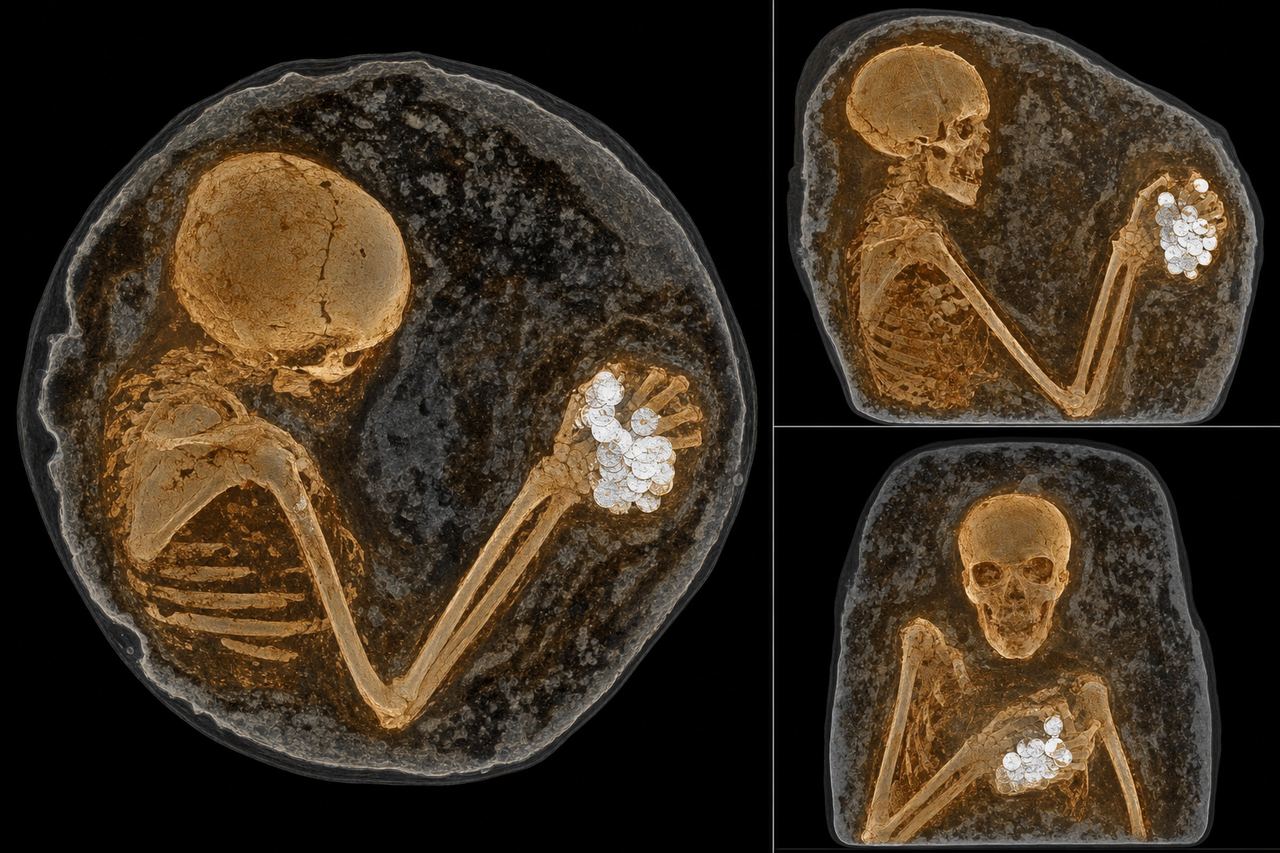
In 2015, a team from the Pompeii archaeological site used medical-grade CT scanners — the same technology used in hospitals to scan living patients — to image the interiors of 86 plaster casts without touching them. For the first time, the world could see the people inside the plaster: their exact skeletal structure, their teeth, their jewellery, the coins in their pockets, the food in their hands.
The Pregnant Woman
Perhaps the most emotionally significant discovery from the CT scans was confirmation of what museum visitors had long suspected from the shape of one of the female casts. Detailed imaging revealed fetal bones within the body of a woman — a pregnant woman, in her second trimester. She was probably in her mid-20s. She had not survived to give birth.
The discovery of the fetal remains moved the cast from a general category of "woman victim" to something more specific and more devastating: a mother and child, together in their last moment, separated by only weeks from a life that never began.
"CT scanning gave us back the people inside the plaster. Not just their shapes, but their bones, their teeth, the rings on their fingers. They became individuals again." — Massimo Osanna, Director, Archaeological Park of Pompeii, 2015
The Man with the Coins
One cast — a man found in a crouching position, arms raised to shield his face — revealed coins in his hand when scanned. He had grabbed his money before fleeing. The coins were identifiable: silver denarii and bronze sestertii, worth enough to suggest he was not wealthy but not destitute. He knew catastrophe was coming. He took what he could carry and ran.
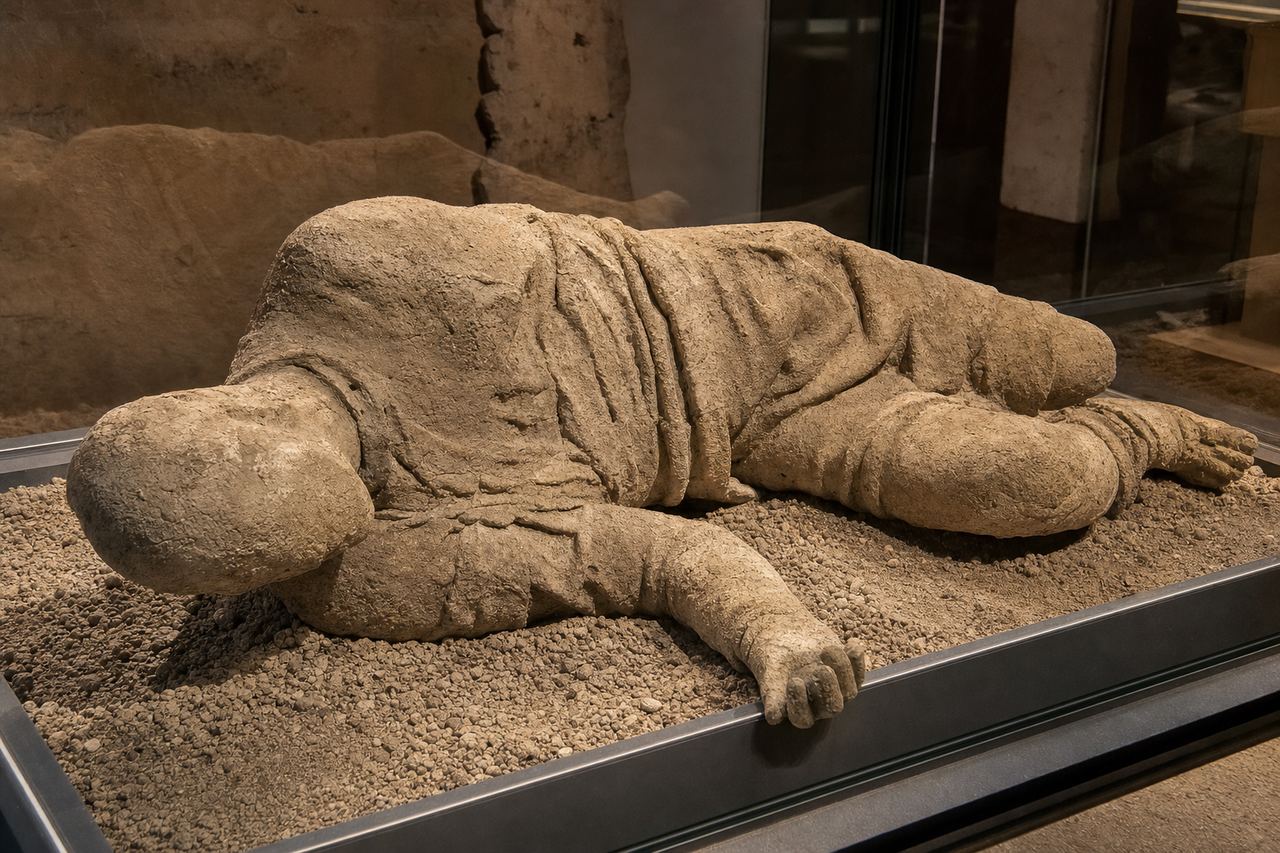
He did not make it far. The position of his body — arms raised, face covered — suggests he died in the first pyroclastic surge, trying to protect himself from the superheated gas and debris. His last act was to shield his eyes from something he could not see but could feel arriving.
The Family Group
Among the most affecting finds in Pompeii are the casts found in the Villa of the Mysteries and other locations showing groups of people together — small families who chose to face the end together rather than scatter. CT scanning of family groups has revealed details impossible to see from the outside.
In one case, scanning revealed that a larger figure was sheltering a smaller one — an adult, arms wrapped around a child. The bones confirmed it: an adult of around 40 and a child of approximately 4 years old. Whether parent and child, or another adult and the child they chose to protect, cannot be determined. But the intention — to shield, to protect, to not die alone — is unmistakable.
The Slaves
CT scanning has also helped identify the social status of victims through analysis of their skeletons and possessions. Several casts have now been identified as probable slaves — identifiable through heavier bone density from physical labour, minimal personal possessions, and positioning in service areas of houses rather than family sleeping quarters.
These individuals were locked in. Slaves in Roman society were property; in an emergency, they may have been chained or otherwise prevented from fleeing. The moral weight of their deaths — people who had no choice in where they lived, and no choice in where they died — adds a particular dimension to Pompeii's tragedy.
The Dog
One of the most famous Pompeii casts is not a person but an animal: a dog, found in the House of Vesonius Primus, still attached to its chain — its back arched, legs extended, the posture of suffocation. CT scanning confirmed the anatomy of the dog: a medium-sized breed with features resembling a modern Maltese or similar companion dog.
The dog had three collar marks around its neck from three separate collars, suggesting it was an old and well-loved pet that had outlived several collars over its lifetime. It died because it was chained and could not escape. Its owner may have fled without freeing it, or may have been one of the dead themselves.
What Is Still Being Found
Pompeii is not fully excavated. Approximately a third of the ancient city has never been systematically dug. Since 2018, a major new excavation project — the Pompeii Grande Progetto — has been uncovering new areas, and new voids are regularly discovered and cast.
In 2020, the complete remains of two men were found in a newly excavated area — an older man with compressed vertebrae suggesting a life of heavy labour, and a younger man, his skull crushed by a large stone block that fell on him as he tried to crawl to safety. The volcanic stone block was still in place above him, exactly as it had fallen almost 2,000 years ago.
Every new cast raises the same impossible questions: who were they? What did they love? What were they afraid of? The CT scanner can tell us their age, their health, their possessions. It cannot tell us their names. They went into the ash as individuals and came out, 2,000 years later, as the last witnesses to a day that ended a world.
Frequently Asked Questions
What actually killed the people of Pompeii — was it lava or something else?
The victims were killed by pyroclastic surges — fast-moving currents of superheated gas, ash, and volcanic debris traveling at over 100 mph. A 2020 study found that body temperatures reached 300°C almost instantly, causing rapid death through extreme heat rather than suffocation or burial. Lava flows never reached Pompeii; the volcanic rock and ash that buried the city came from these successive surges and fallout.
When exactly did most people in Pompeii die during the eruption?
Most deaths occurred on the morning of August 25, 79 CE, during the second and most destructive phase of the eruption. The initial ash fall on August 24 gave some residents time to flee, but the catastrophic pyroclastic surges that swept through the city in the early hours of the following morning killed those who had remained behind, nearly instantaneously.
How were the famous body casts of Pompeii created?
When the victims were buried under meters of volcanic ash, their bodies decomposed over centuries, leaving hollow cavities in the hardened material. In the 19th century, archaeologist Giuseppe Fiorelli pioneered a technique of injecting plaster into these voids, preserving the exact shape and posture of each person at the moment of death. The resulting casts capture details as fine as facial expressions, clothing folds, and the curl of fingers.
What do the body casts reveal about how people behaved in their final moments?
The casts show a range of instinctive human responses: individuals sheltering against walls, adults curled protectively around children, and people embracing one another. Some victims were found clutching valuables or covering their faces with cloth. These preserved postures indicate that many people were conscious of the danger and reacted to it, yet the pyroclastic surge struck with such speed that escape was impossible.