Europeans in the Heart of Asia
In the early 20th century, archaeologists excavating burial sites in the Tarim Basin — a vast desert depression in what is now Xinjiang, western China — began finding something they could not explain. The bodies were tall. Their hair was reddish-brown or blonde. Their facial features were distinctly European. They were wearing plaid woollen textiles. And they had been buried in western China, thousands of kilometres from Europe, nearly 4,000 years ago.
The extreme dryness of the Tarim Basin's Taklamakan Desert — one of the world's driest places — had preserved them as naturally desiccated mummies, their skin intact, their clothing preserved, their features clearly legible. They are among the most controversial and significant archaeological finds of the modern era.
The Cherchen Man
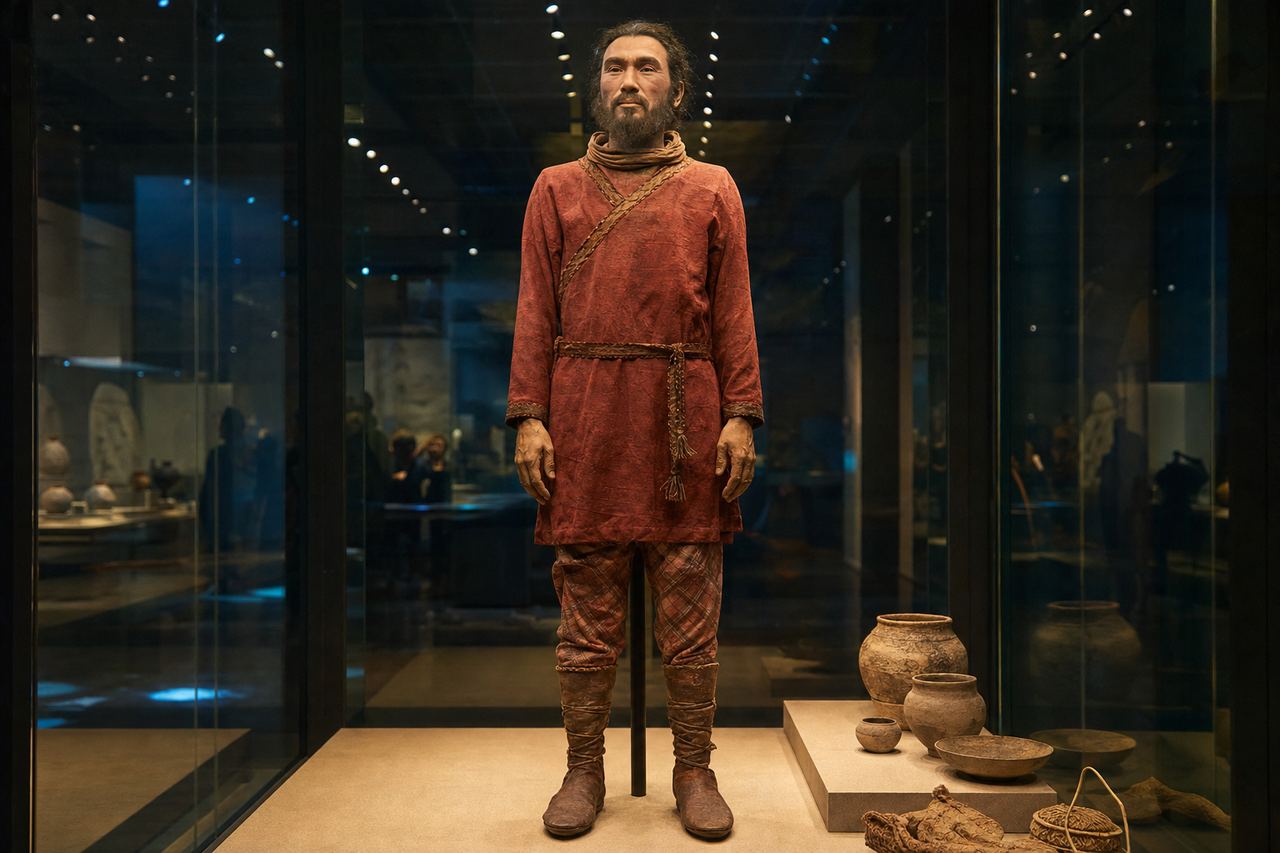
The most famous of the Tarim mummies is the Cherchen Man — a male found near the town of Cherchen (Qiemo), dating to approximately 1000 BCE. He stands 1.80 metres tall — exceptional for the ancient world. His hair is reddish-brown with streaks of grey. He wears a red tunic and tartan-like leggings in burgundy and blue. His boots are of soft leather. His face bears what appear to be tattoos or ritual facial markings.
Buried with him were three women and an infant. The infant was wrapped in a blue wool blanket and had small stones placed over its eyes — possibly to protect the deceased's vision in the afterlife. The women were tall and European-featured, their clothing as colourful and complex as the man's.
The Loulan Beauty
One of the earliest and most celebrated finds is the "Loulan Beauty" — a woman found near the ancient Silk Road city of Loulan, dating to approximately 1800 BCE, making her one of the oldest Tarim mummies. She was around 45 years old at death, with high cheekbones, a narrow face, and light brown hair. Her clothing — a wool cloak fastened with a bone pin — and her woven hat have been analysed in detail.
Her features were so strikingly non-Asian that when photographs were first published in the 1990s, they sparked immediate controversy across the region. Uyghur nationalists pointed to the mummies as proof of their deep roots in Xinjiang; Chinese authorities were more cautious in their interpretation.
"These people looked nothing like we expected to find in western China. They looked like people you might pass on the street in Dublin or Stockholm. But they had been here for four thousand years." — Victor Mair, University of Pennsylvania, on first seeing the mummies
The DNA Revolution
For decades, the origin of the Tarim mummies was fiercely debated. Were they proto-Celtic Europeans who had migrated east? Were they from Iran? From South Asia? Every theory generated political as well as academic controversy.
In 2021, a landmark genomic study published in Nature answered the question definitively — and the answer was surprising. The Tarim mummies were not migrants from anywhere. Their DNA showed they were descended from an Ancient North Eurasian population that had been genetically isolated for thousands of years — a population with no significant mixture with other groups for at least 9,000 years before the mummies were buried.
They were not Europeans who travelled to China. They were a separate, ancient people who happened to share some physical characteristics with Europeans — because both groups descended from the same ancestral population, tens of thousands of years earlier.
Their Civilisation
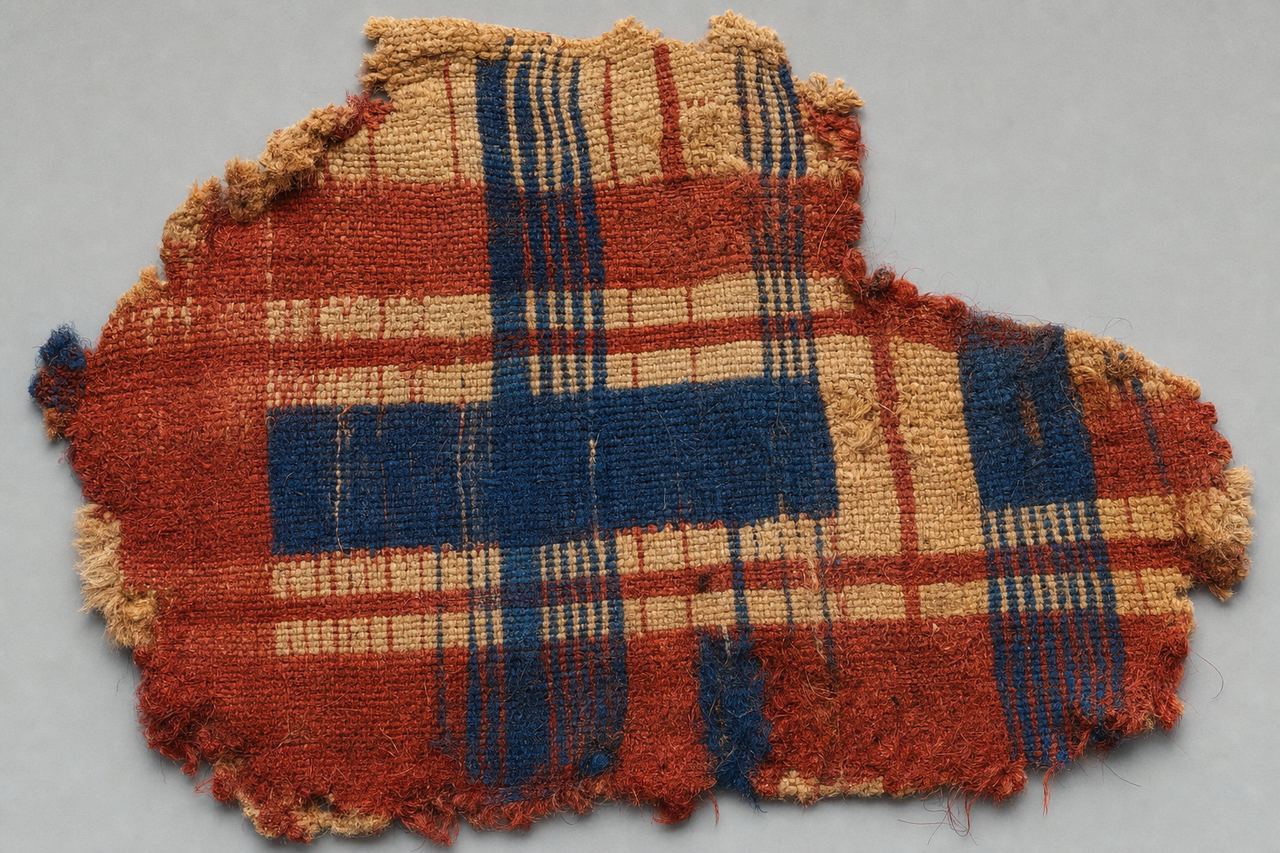
The Tarim mummies were not primitive nomads. Their textiles — some of the most complex preserved fabrics from the ancient world — show knowledge of advanced weaving techniques. Their clothing used vegetable dyes to create patterns that closely resemble early Celtic and Hallstatt textiles from Europe, despite no direct cultural contact between the two regions.
They herded cattle and raised crops in oasis settlements along the edges of the Taklamakan Desert. They spoke a language — or possibly languages — belonging to the Tocharian branch of the Indo-European family, the easternmost branch of that linguistic tree. Tocharian manuscripts survive from the 6th to 8th century CE, discovered in the same region where the mummies were found.
Why They Matter
The Tarim mummies challenge several assumptions about ancient Asia. They demonstrate that the Tarim Basin — today a desert almost universally associated with Chinese and Central Asian cultures — was home to a genetically and culturally distinct population thousands of years before the Silk Road brought cultural exchange to the region.
They also demonstrate the extraordinary preserving power of extreme aridity. While the permafrost of Siberia and the Alps freeze bodies in cold, the Taklamakan desiccates them in heat and dryness. The result is the same: the dead refusing to decompose, insisting on being remembered, waiting in the sand for someone to find them and ask who they were.
Where They Are Today
The best-preserved Tarim mummies are displayed at the Xinjiang Museum in Ürümqi, the capital of the Xinjiang Uyghur Autonomous Region. The Cherchen Man, the Loulan Beauty, and several other mummies are on permanent display. Access to the collection has at times been restricted for political reasons, and the question of who owns the cultural narrative of these ancient people remains contested.
Frequently Asked Questions
Where exactly were the Tarim Mummies discovered?
The mummies were found in the Tarim Basin in present-day Xinjiang, western China, buried in arid desert conditions that include the edges of the Taklamakan Desert. Sites such as Cherchen, Loulan, and Subeshi have yielded the most significant finds. The extreme dryness of the region — combined in some cases with salt — naturally desiccated the bodies over millennia, preserving soft tissue, hair, and clothing in remarkable detail.
Why do so many Tarim Mummies have light-colored hair and Western physical features?
A landmark 2021 study published in Nature analyzed ancient DNA from 13 individuals and confirmed that the Tarim Mummies descended from an isolated Ancient North Eurasian population with deep West Eurasian genetic roots. They were not migrants from the Pontic Steppe, the Near East, or South Asia, but a remnant of an ancestral group that had been genetically isolated for thousands of years. Their light hair and tall stature reflect this distinct ancestry, not a recent migration from Europe.
Who is Cherchen Man, and why is he considered the most famous of the Tarim Mummies?
Cherchen Man is a male individual discovered at the site of Zaghunluq near the town of Cherchen, dating to roughly 1000 BCE, making him approximately 3,000 years old. He stands around 1.8 metres tall and was found with reddish-brown hair, a beard, and an elaborate burial that included colorful woolen garments and ten hats. His exceptional state of preservation, striking physical appearance, and rich grave goods have made him the most widely recognized and studied individual from the Tarim Basin.
What do the Tarim Mummies reveal about early Bronze Age life in Central Asia?
The mummies' clothing and grave goods show sophisticated textile production, including tartan-patterned wool garments woven using techniques comparable to those found in Bronze Age Europe. Dietary isotope studies indicate a mixed economy involving herding and some agriculture. Taken together, the burials suggest a culturally complex society with long-distance trade connections, challenging earlier assumptions that the Tarim Basin was a peripheral region with little cultural development before the later Silk Road era.