The Ukok Plateau
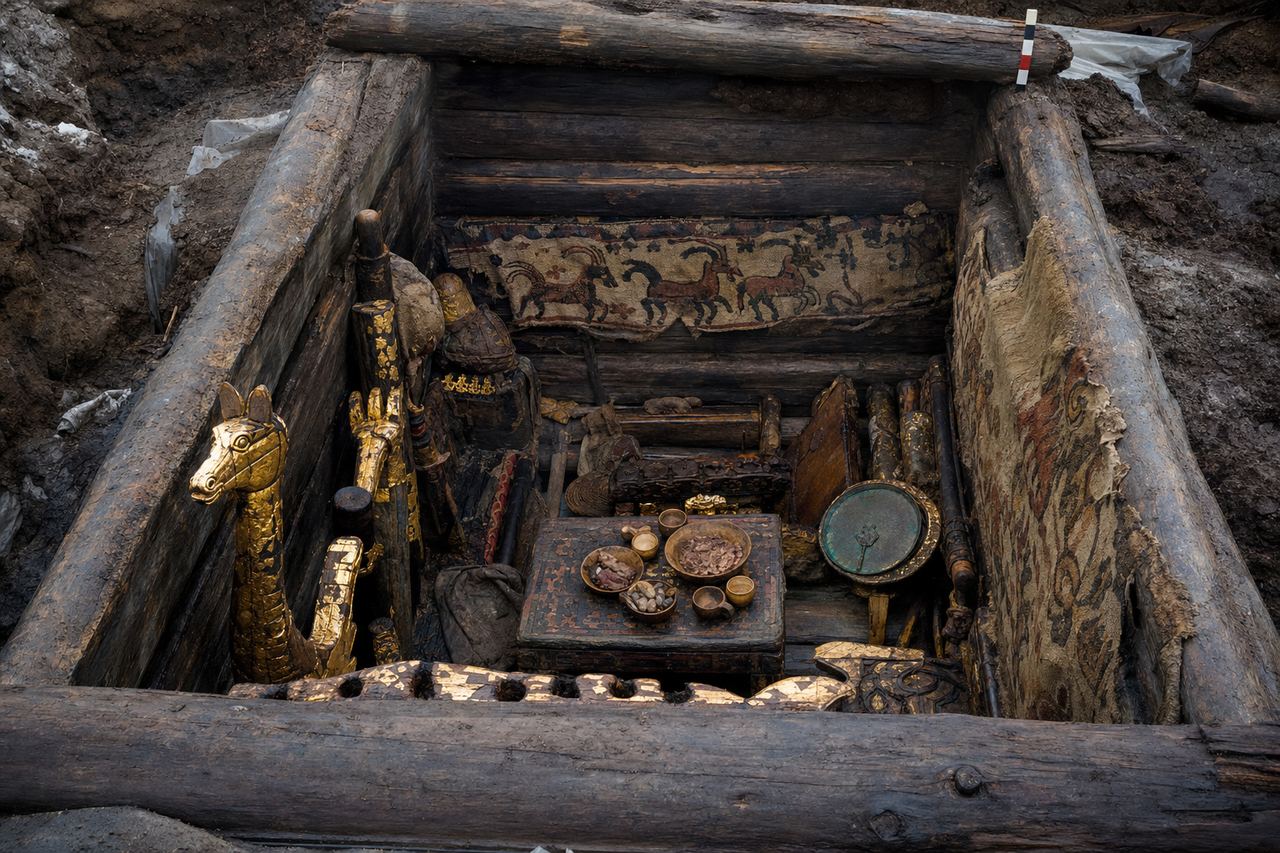
In 1993, archaeologist Natalia Polosmak excavated a burial mound on the remote Ukok Plateau in Siberia's Altai mountains — at 2,400 metres, near the borders of China, Mongolia, and Kazakhstan. Under permafrost ice, perfectly preserved for 2,500 years, lay a young woman in a carved larch coffin. Six saddled horses had been sacrificed to accompany her, along with vessels of fermented mare's milk and a silver mirror.
The Tattoos
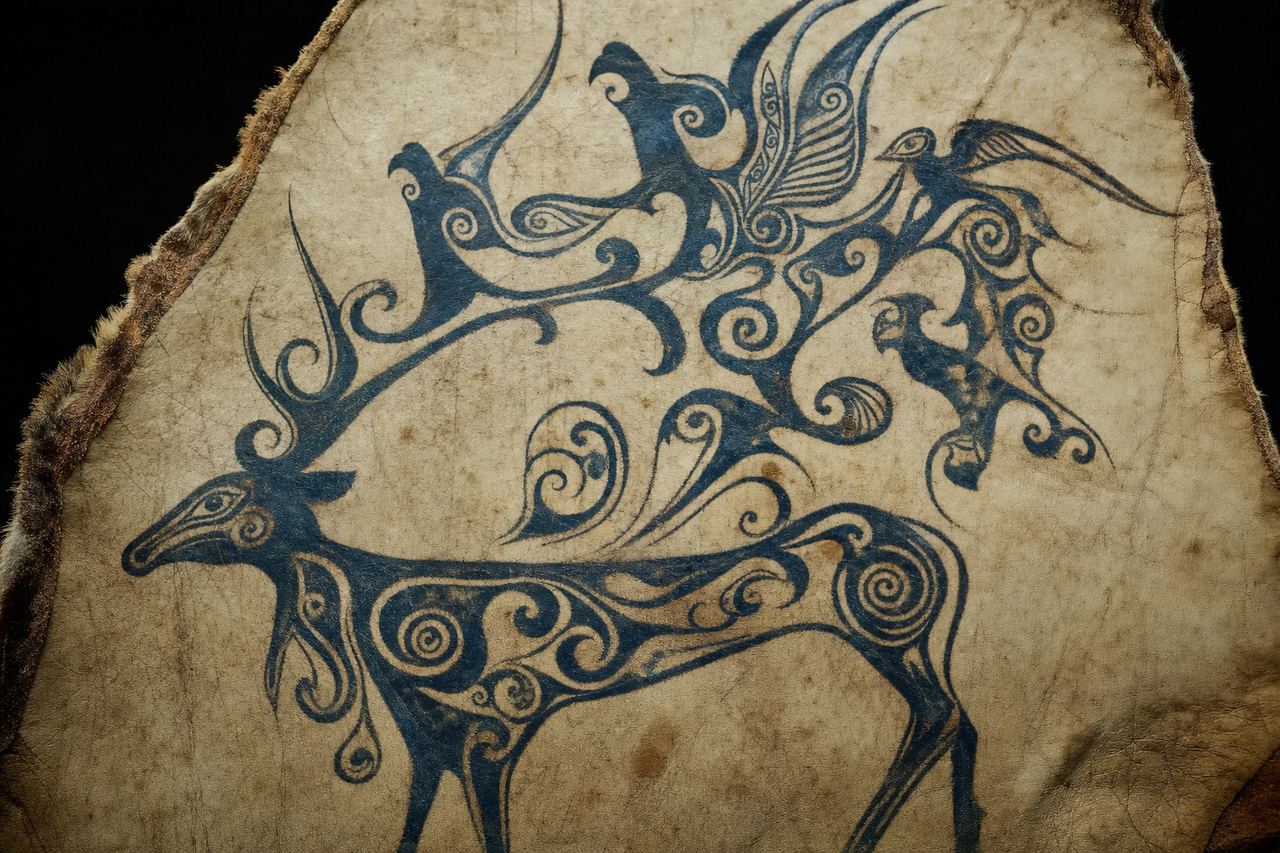
What makes her uniquely remarkable is her tattoos: on her left shoulder, a deer with antlers that transform into flowers at their tips. A snow leopard on her wrist. Ibex and other animals on her fingers and forearms. Created by pricking charcoal under the skin, they are considered among the most beautiful ancient tattoos ever preserved. They identify her as a high-status member of the Pazyryk nomadic culture.
Her Life and Death
She was 25 to 28 years old, approximately 1.67 metres tall. CT scanning in 2014 revealed she had breast cancer, osteomyelitis, and injuries consistent with a fall from a horse. She was in great pain in her final years. Some researchers believe her death may have been hastened by mercy.
The Tattoos in Detail
Of everything recovered from the Ukok burial, it is the tattoos that have drawn the most sustained study. Both of her arms, from shoulder to wrist, were covered in designs executed with a precision that specialists have found difficult to match even by modern tattooing standards. The centrepiece is a large deer — its body rendered with careful musculature, its antlers rising and then branching outward, each tip curling into a stylised flower. Alongside the deer: a snow leopard, mountain rams, a mythical creature with a griffin's beak, and further geometric ornaments on her fingers.
The technique was pricking: a sharp instrument was used to drive charcoal or another dark pigment beneath the skin, dot by dot. After 2,500 years in permafrost, the designs remain legible and detailed. Pazyryk tattoos have been found on other frozen mummies from the same culture, but none approach the complexity or preservation quality of hers. Archaeologists regard them as the finest examples of Scythian body art in existence, and they are now a primary source for understanding Pazyryk visual culture and its symbolic language.
Her Illness and Death
MRI and CT scans conducted in 2014 at the Novosibirsk Institute of Trauma and Orthopaedics gave researchers their first detailed picture of her physical condition at death. The findings were grim. She had breast cancer — a primary tumour visible in the scan — as well as osteomyelitis, a bone marrow infection that causes severe chronic pain. There were also injuries consistent with a fall from a horse: trauma to the right shoulder and arm that had not fully healed before she died. She was, in short, a woman in serious and continuous pain during her final period of life.
The presence of cannabis seeds in her burial chamber has led some researchers to suggest she may have been sedated with cannabis smoke to manage that pain — a practice documented in other Scythian contexts. Whether her death came from disease, a deliberate act of mercy, or some other cause cannot be determined from the remains alone. What is clear is that she was buried with exceptional care: dressed in silk, placed in a carefully constructed coffin, accompanied by six horses whose saddles and harnesses were themselves works of craftsmanship. The community that buried her did not bury her as an ordinary person.
The Political Controversy
The excavation of the Ukok Plateau burial became one of the most contested repatriation cases in modern archaeology. For the indigenous Altai people, the Ukok Plateau is sacred ground — the boundary between the human world and the realm of the dead. Removing the Ice Maiden from her burial site was, in their view, a profound violation that carried consequences. In the years following her removal in 1993, the Altai Republic experienced several significant floods and a major earthquake in 2003. The connection is not scientific, but it was deeply felt.
Protests, legal challenges, and formal petitions to the Russian government followed over nearly two decades. The Russian Academy of Sciences initially refused repatriation, citing the scholarly value of keeping the remains at the Novosibirsk Institute where she was studied. In 2012, she was returned to the Altai Republic and placed in a purpose-built refrigerated sarcophagus at the National Museum in Gorno-Altaysk, where she remains. The case established a precedent that continues to influence how Russian archaeologists negotiate with indigenous communities over excavation rights in Siberia.
Frequently Asked Questions
Where is the Siberian Ice Maiden now?
After years of controversy, the Siberian Ice Maiden was returned to the Altai Republic in 2012. She is now displayed at the National Museum of the Republic of Altai in Gorno-Altaysk, housed in a purpose-built refrigerated sarcophagus. The indigenous Altai people had campaigned for her return since her removal in 1993.
Who was the Siberian Ice Maiden?
She was a woman of the Pazyryk culture, a nomadic Scythian people who inhabited the Eurasian steppe around 500 BCE. She was approximately 25 years old at death, and her elaborate burial — with six sacrificed horses, fine clothing, and a carved larch coffin — indicates high social rank. She may have been a shaman, healer, or aristocrat, though her precise role in Pazyryk society is still debated.
Why is the Siberian Ice Maiden controversial?
The indigenous Altai people regard her as a direct ancestor whose spirit protects the land. Her removal from the Ukok Plateau in 1993 was followed by a series of floods and earthquakes in the Altai region, which many locals attributed to the disturbance of her burial. There were organised protests and legal challenges, ultimately resulting in her return to Altai in 2012. The case has since become a landmark example in debates over indigenous repatriation rights.
What do her tattoos show?
Her tattoos cover both arms from shoulder to wrist and depict animals in the distinctive Pazyryk style: a large deer whose branching antlers transform into flowers at their tips, a snow leopard, mountain rams, and other mythical hybrid creatures. The designs were made by pricking charcoal pigment under the skin. After 2,500 years in permafrost they remain clear and detailed — widely considered the finest examples of Scythian tattooing ever found.