The Discovery
On 19 September 1991, Helmut and Erika Simon were hiking in the Ötztal Alps when they noticed a body in the ice. Police and mountain rescue were called. When the body was freed, archaeologists realised the man had been there for over 5,000 years.
Who He Was
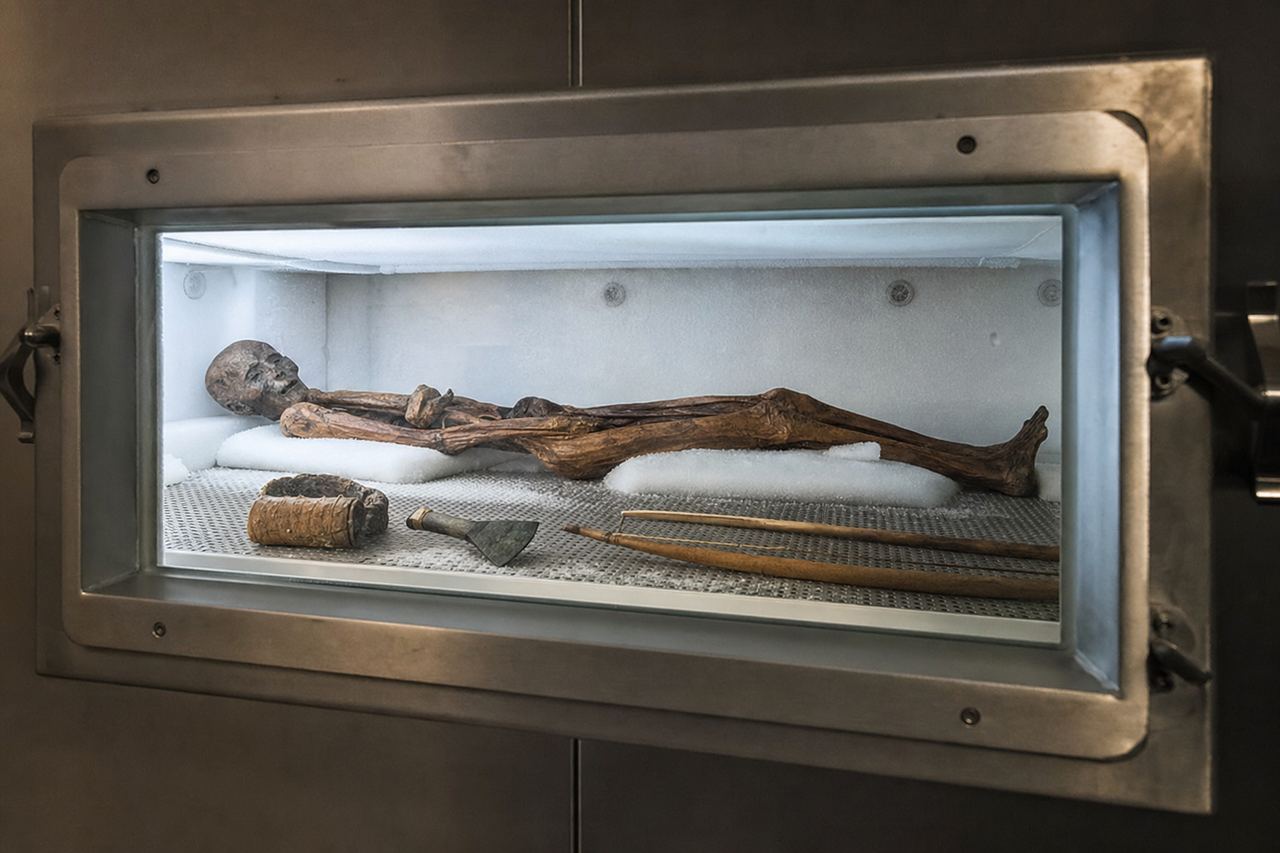
Ötzi was between 45 and 46 years old — old by Copper Age standards. His DNA reveals brown eyes, type O blood, lactose intolerance, and a predisposition to cardiovascular disease. His last meal, eaten less than 30 minutes before his death: red deer, ibex, einkorn wheat, and bracken fern.
The Murder
For years, scientists believed Ötzi died of exposure. In 2001, an X-ray revealed an arrowhead lodged in his left shoulder — shot from behind while eating. He bled to death in minutes from a severed subclavian artery. He also had defensive wounds on his right hand from a fight in his final hours. Someone wanted him dead.
"He is not a stranger. He had worries, problems, love and hate. He had a life."— Albert Zink, EURAC Institute for Mummy Studies
His Belongings
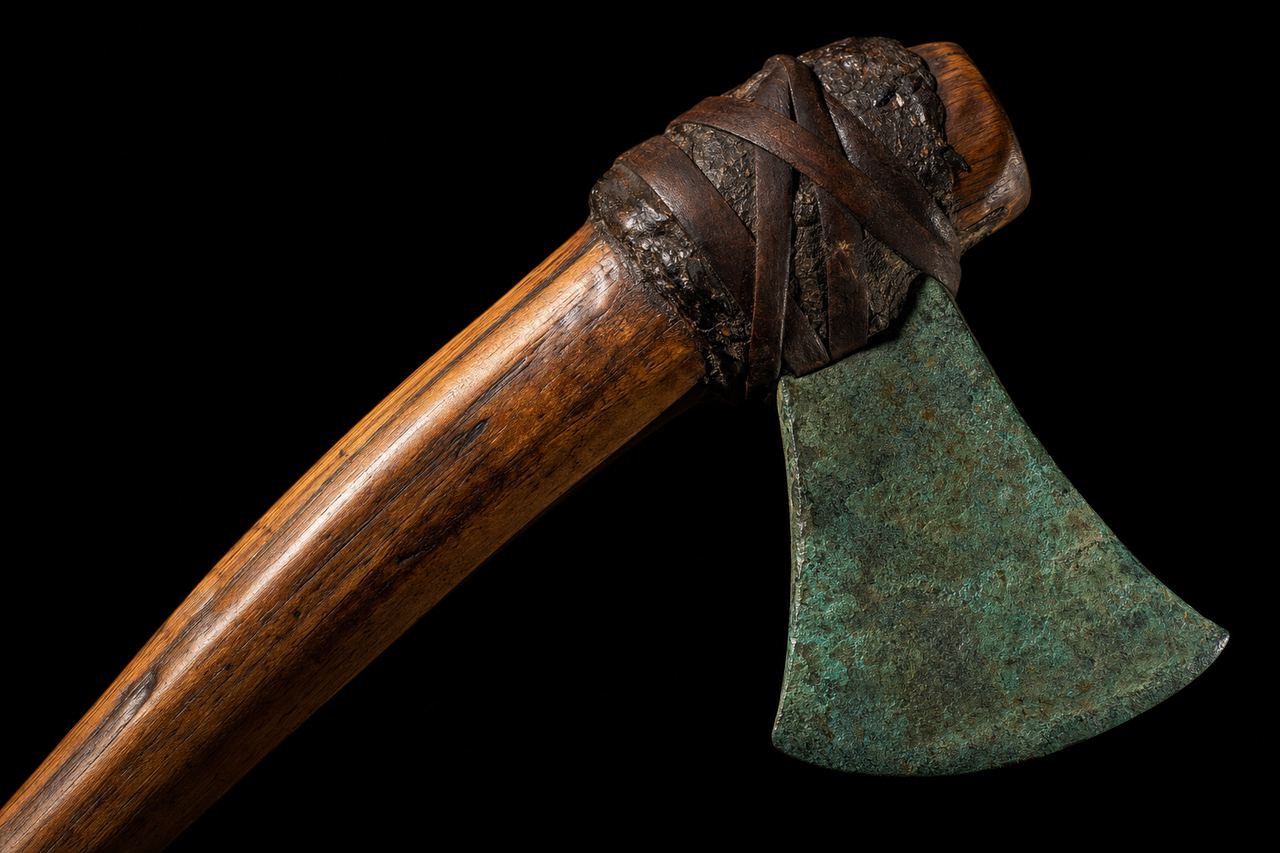
Ötzi was not travelling light. With him when he died was one of the most complete sets of personal equipment ever recovered from the Copper Age: a copper-bladed axe with a yew handle — still sharp enough to cut, still functional after 5,300 years — which alone tells us he was a man of some status, since copper axes were expensive and rare. A yew longbow, 1.82 metres long, was found unfinished, without its string — he was still working on it at the time of his death. His quiver held 14 arrows, only two of them finished with flint tips and fletching; the others were works in progress.
He also carried a flint dagger, a retoucheur (a bone tool for resharpening flint), an antler spike, birch-bark containers that had been used to carry embers for fire, and a fire-starting kit consisting of flint, pyrite, and tinder fungus. His clothing was assembled from at least five different animal species — bear, deer, ibex, sheep, and cattle — sewn together with remarkable skill. A grass cloak offered additional insulation and waterproofing. Taken together, his kit reads as that of an experienced alpine traveller who knew exactly how to survive in the mountains. He was not a lost wanderer. He was on his way somewhere when someone stopped him.
His DNA
When Ötzi's genome was fully sequenced in 2012, it upended several assumptions about prehistoric European populations. He had no living male-line descendants — his Y-chromosome haplogroup is rare today but most closely related to populations in Sardinia, suggesting that his genetic community was largely absorbed or displaced by later migrations into central Europe. He was genetically most similar to modern Sardinians, Corsicans, and other western Mediterranean island populations, whose isolation preserved what mainland Europeans later lost.
Beyond ancestry, his genome revealed a man already carrying multiple health burdens. He had a genetic predisposition to cardiovascular disease — and arteriosclerosis was confirmed in his vessels. He had Lyme disease, making him one of the earliest known cases. He carried intestinal parasites. His joints showed arthritis. The man shot in the Alps was not healthy; he was middle-aged, chronically ill, and still walking at altitude carrying 8 kilograms of equipment. Whatever drove him into the mountains on that last day, it mattered enough to push through the pain.
Who Killed Him — and Why
The murder weapon — a flint arrowhead lodged in Ötzi's left shoulder — is made from a type of stone not found among his own arrowheads. His arrows used a different material. The arrowhead that killed him was made by someone else, with different supplies, in a different place. The killer was not Ötzi's travelling companion — or if they were, they had their own tools.
Three theories dominate the academic debate. Robbery is possible — though his copper axe, the most valuable item he carried, was left with the body. A personal feud fits the ambush-style execution, being shot from behind while eating suggests he did not fear the person approaching. Ritual killing has also been proposed, though evidence for this remains thin. What is clear is that the killing was deliberate and specific. Whoever shot him wanted him dead, not robbed. After 5,300 years, the motive remains open.
Frequently Asked Questions
Where is Ötzi the Iceman now?
Ötzi is kept in a specially built refrigeration chamber at the South Tyrol Museum of Archaeology in Bolzano, Italy. The chamber maintains conditions close to those of his glacier — approximately −6°C and 99% humidity. Visitors can view him through a small window in the cold room.
How was Ötzi preserved so well?
Ötzi died in a natural rocky depression on the mountain, which shielded his body from glacial movement that would otherwise have crushed him. Snow covered him quickly after death, and he remained encased in the glacier for over 5,000 years. The stable sub-zero temperature prevented decay while the ice slowly freeze-dried his tissues.
Who killed Ötzi?
The killer has never been identified. What is known: Ötzi was shot from behind with an arrow that severed his subclavian artery, causing rapid death. The arrowhead was made from a different stone than Ötzi's own arrowheads, suggesting it was made by a different person. Whether the motive was robbery, a personal feud, or ritual violence remains a matter of active scientific debate.
What did Ötzi carry with him?
Ötzi carried a remarkably complete survival and tool kit: a copper-bladed axe, a yew longbow (unfinished), a quiver with 14 arrows, a flint dagger, a grass cloak, birch-bark containers for carrying embers, and a fire-starting kit with flint, pyrite, and tinder fungus. Together these objects represent the most complete assemblage of Copper Age personal equipment ever found.