The Forgotten King
Tutankhamun ruled for just nine years, dying around 1323 BCE at approximately 19 years of age. His successors tried to erase him from history — chiselling his name from monuments, reassigning his victories. Then, on 4 November 1922, Howard Carter's team found the top step of a buried staircase in the Valley of the Kings. It led to the only intact royal tomb ever found in Egypt.
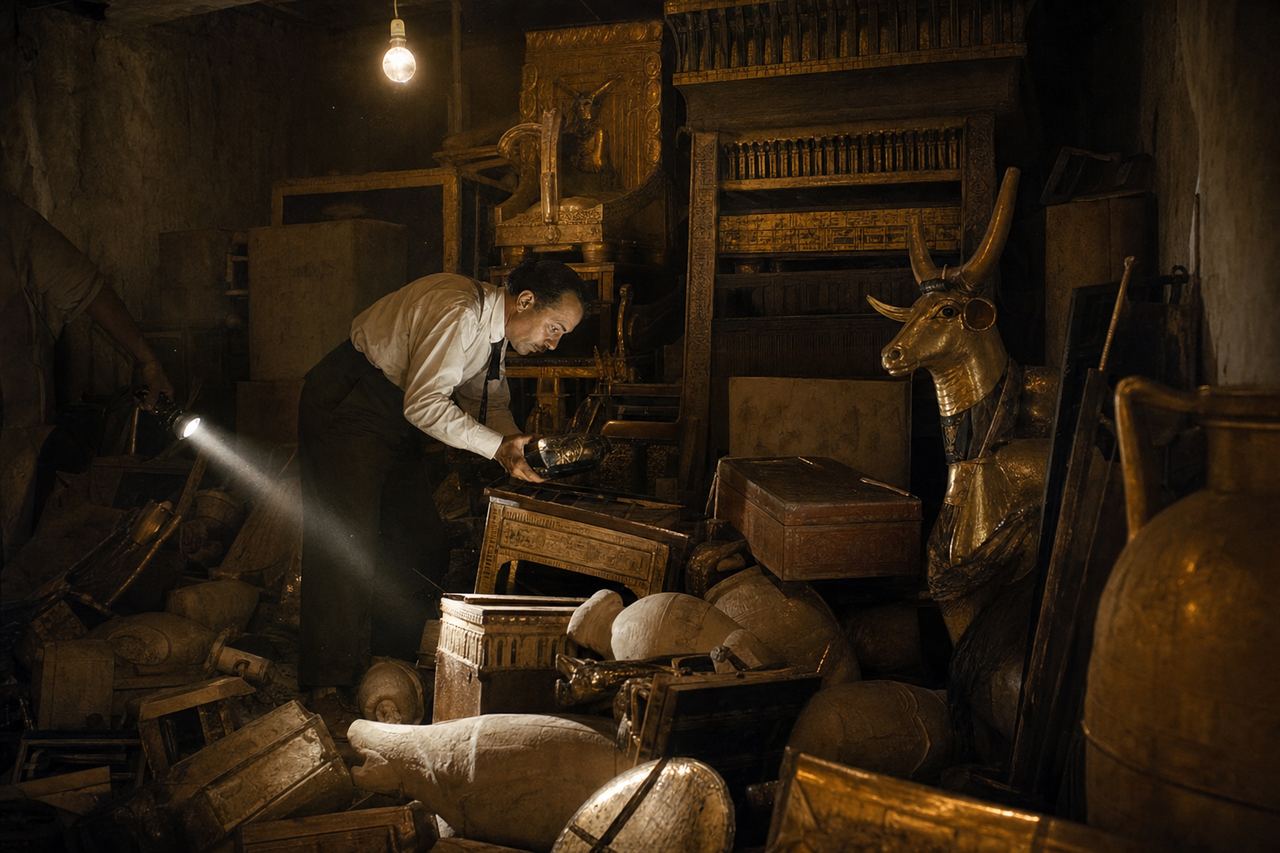
"As my eyes grew accustomed to the light, details emerged slowly: strange animals, statues, and gold — everywhere the glint of gold."— Howard Carter, 1922
The Tomb's Contents
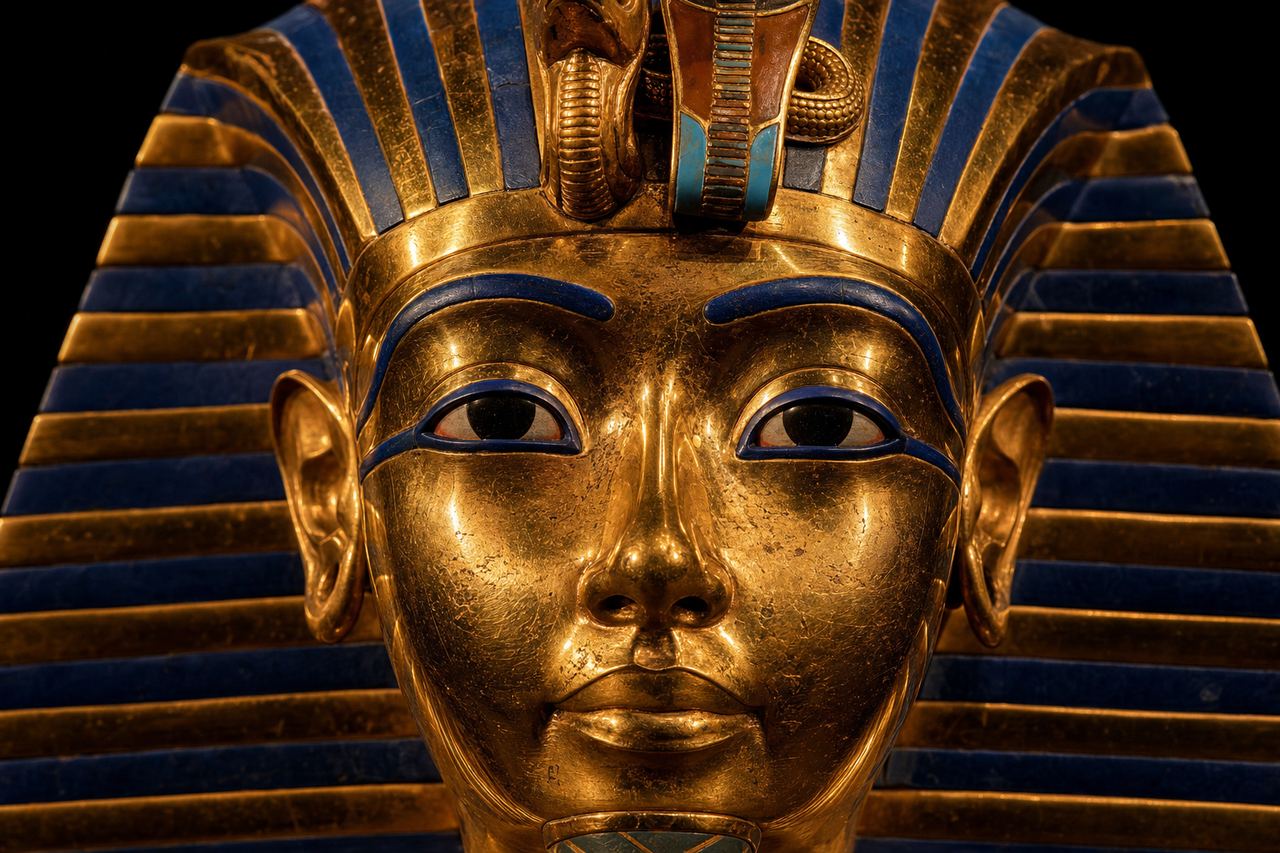
The antechamber alone held over 5,000 objects. At the heart were four nested shrines, three coffins — the innermost solid gold — and the boy king himself, still wearing his famous gold death mask. It took Carter ten years to catalogue the entire contents.
His Mummy
CT scans in 2005 and 2010 revealed he had a broken leg, a club foot, and malaria. He was more frail than his royal imagery suggested. No consensus exists on his cause of death: chariot accident, infected wound, murder, or disease. The truth remains sealed with him in Cairo.
His Bloodline and Its Cost
DNA analysis published in 2010 in the Journal of the American Medical Association identified Akhenaten — the heretic pharaoh who dismantled Egypt's traditional religion — as Tutankhamun's father. His mother was Akhenaten's own full sister, unnamed in surviving records. Their union was not merely dynastic convenience; it was theological, a royal bloodline kept deliberately pure. The cost was severe. Tutankhamun's skeleton shows bone necrosis in his left foot consistent with Köhler disease, fused vertebrae, and an impacted wisdom tooth. He walked with a cane — over 130 canes were found in his tomb, many showing real signs of use.
His two daughters, both stillborn, were found mummified inside tiny coffins within the tomb. DNA confirmed they were his children. He died without an heir, and with him ended the 18th Dynasty's direct line. His successor Ay, then the general Horemheb, spent years systematically erasing his name from history — the damnatio memoriae that nearly worked.
The Curse and What Carter's Dig Actually Killed
Lord Carnarvon died on 5 April 1923 — five months after the tomb's opening — from blood poisoning following an infected mosquito bite. The press declared the curse active. In truth, Carnarvon was already in poor health; he had suffered severe internal injuries from a car accident years earlier. Howard Carter, who stood in the burial chamber longer than anyone, lived until 1939. Of the 26 people present at the formal opening of the burial chamber, a study found their average age at death was 73 — unremarkable for men of their social class in that era.
Where the items went is a question that still runs through auction houses today. The 5,000-plus objects from KV62 are primarily held at the Egyptian Museum in Cairo, with a large portion now displayed at the Grand Egyptian Museum at Giza, which opened fully in 2023. Tutankhamun's golden death mask — weighing 10.23 kilograms of solid gold — remains among the most visited museum objects in the world. The mummy itself has never left its tomb.
Frequently Asked Questions
Where is Tutankhamun's mummy now?
Tutankhamun's mummy remains in his original tomb in the Valley of the Kings (KV62), inside the outermost of his nested coffins. It is the only royal mummy still lying in its own tomb rather than in a museum. His treasures — including the golden death mask — are housed at the Egyptian Museum in Cairo, with selected pieces now also displayed at the Grand Egyptian Museum at Giza.
What killed Tutankhamun?
No definitive cause of death has been established. CT scans revealed a fractured left leg — possibly sustained shortly before death — along with a club foot, fused vertebrae, and multiple malaria infections. Some researchers favour a chariot accident or an infected wound; others point to the accumulated effects of genetic disorders caused by close inbreeding within the royal family. No evidence of murder has been confirmed.
Was the Curse of Tutankhamun real?
The so-called curse was a product of press sensationalism in 1922–1923. Lord Carnarvon died in April 1923 from blood poisoning after a mosquito bite. Statistical analyses of those present at the opening show no unusual mortality rate compared with the general population of the same age group at the time. Howard Carter, who spent the most time inside the tomb, lived another 16 years.
Who was Tutankhamun's father?
DNA analysis published in 2010 identified Akhenaten as Tutankhamun's father. His mother was a full sister of Akhenaten, making his parents siblings. This pattern of close royal intermarriage was common among the late 18th-Dynasty pharaohs and contributed directly to the physical ailments visible in Tutankhamun's skeleton — including bone necrosis, a club foot, and fused vertebrae.