The Sacred Animals of Egypt
Egyptian gods manifested on Earth in animal form. Anubis as a jackal. Horus as a falcon. Thoth as an ibis. To honour these gods, Egyptians mummified their animal representatives in numbers that stagger the imagination — over 70 million animals in total.
The Animal Factories
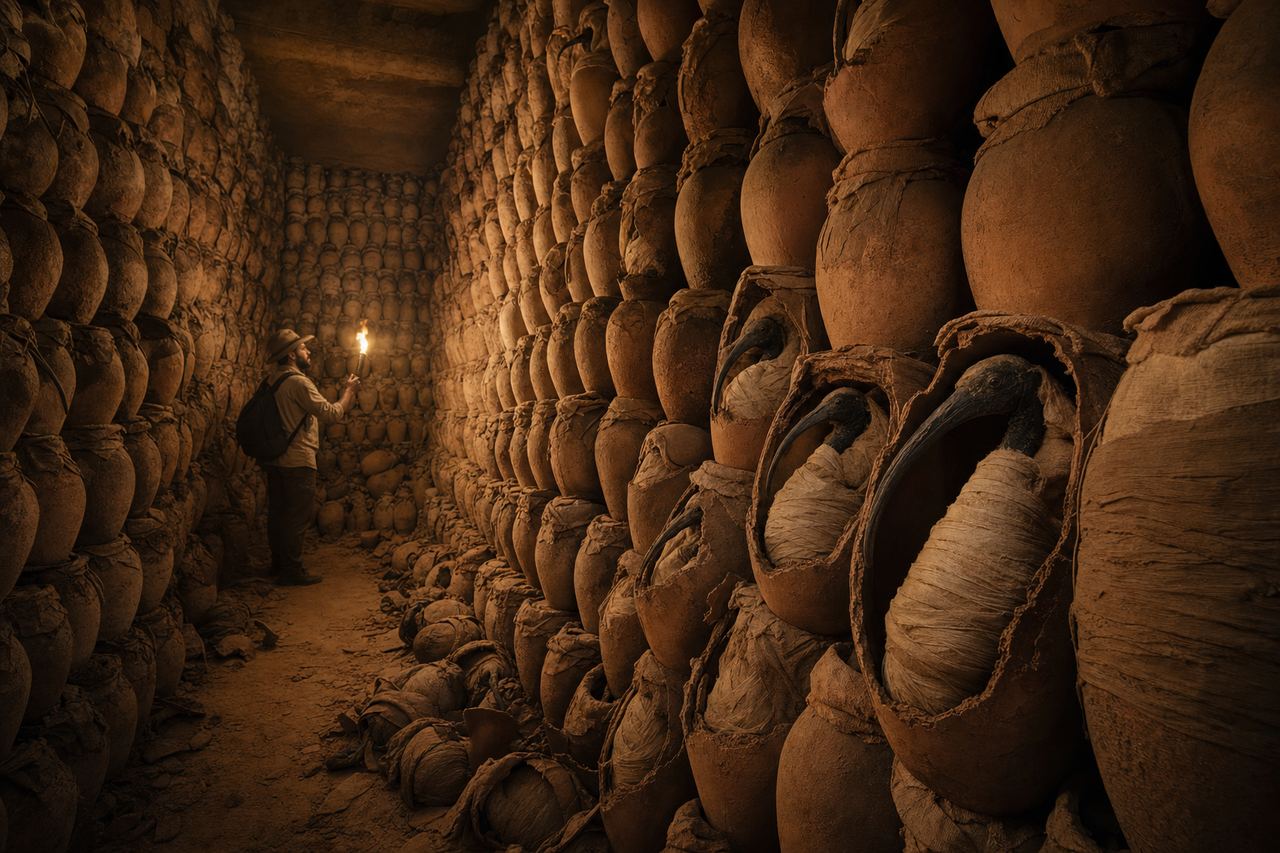
Near the great temple complexes, vast breeding facilities supplied the demand. Thousands of ibises were farmed near Hermopolis; crocodiles raised near Kom Ombo; cats bred near Bubastis. Pilgrims could purchase an animal mummy as an offering to the relevant god — like buying a candle in a church.
What CT Scans Found
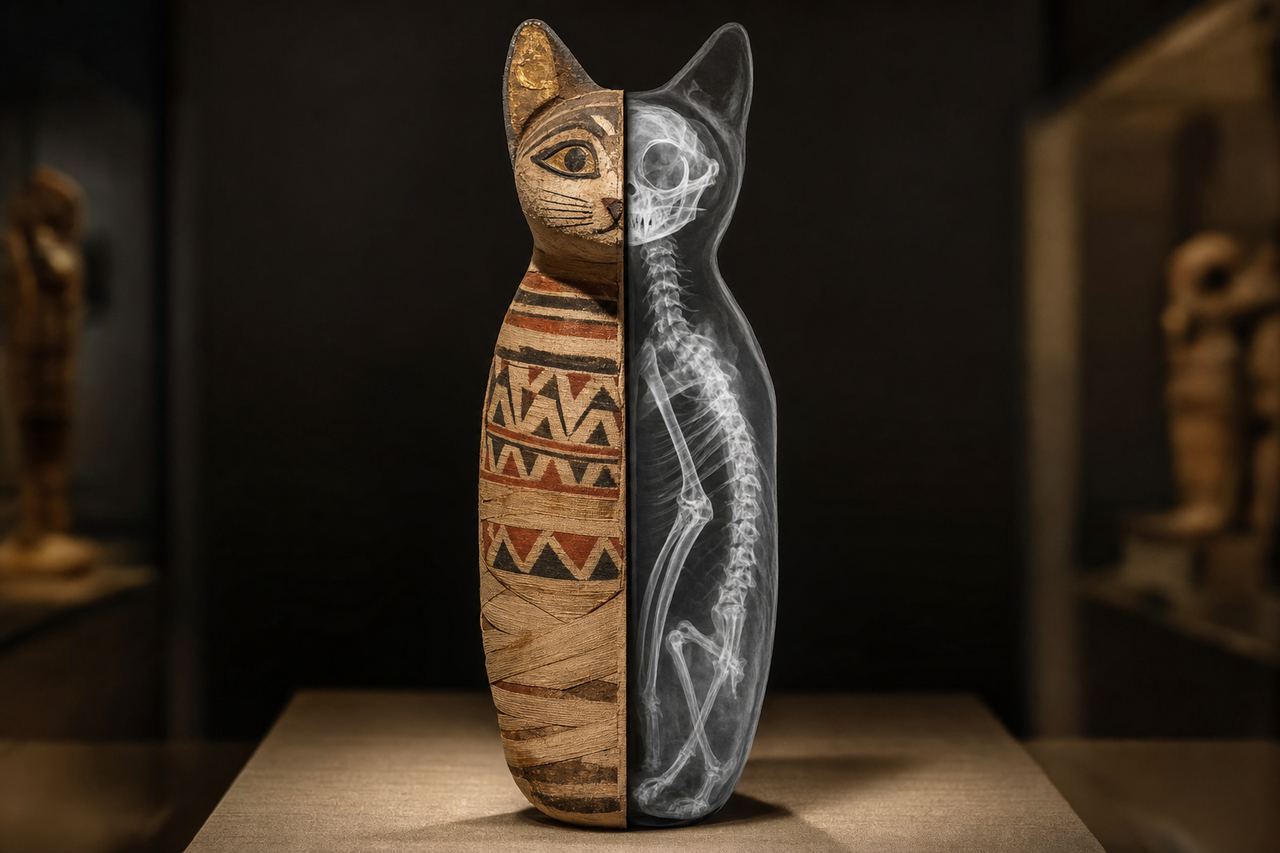
Many animal mummies contain nothing — just rolled linen or random bone fragments. Temple priests appear to have run a profitable scam. Others are genuine: the crocodile mummies of Kom Ombo, over three metres long with their scales intact; cat mummies so detailed that individual whisker follicles are preserved.
"To kill a cat, even accidentally, could mean death for the killer. When a cat died naturally, the entire household shaved their eyebrows in mourning."— Herodotus, 5th century BCE
The Scale of the Industry
The votive animal mummy trade was not a marginal religious practice — it was an economy. At the height of the Late Period (664–332 BCE) and Ptolemaic era (332–30 BCE), the demand for animal offerings at sacred sites was so vast that temple workshops operated as permanent slaughterhouses. Ibises were the most heavily exploited: CT scans of specimens from the Saqqara ibis galleries show the birds were typically killed by a sharp blow to the neck or by having their necks wrung — efficient, fast, industrial. Many were juvenile birds, suggesting they were farmed rather than caught wild. The sheer volume of ibis mummies at Saqqara alone — some estimates run to 4 million birds in a single underground gallery system — implies an operation running continuously for centuries.
The Apis bull cult at Saqqara represents the opposite extreme. Each Apis bull was a singular divine manifestation: one animal at a time, identified by specific markings (a white triangle on the forehead, a crescent on the flank), venerated throughout its natural life in a dedicated temple, and upon death mummified with the same care as a pharaoh. The Serapeum at Saqqara holds 24 of these bulls in granite sarcophagi, each weighing 60 to 80 tonnes, in a tunnel system extending hundreds of metres underground. The contrast — millions of mass-produced ibis bundles versus one immaculately preserved bull per generation — captures the full range of Egyptian animal veneration.
Fraud and the Modern Trade
A 2015 study led by researchers at the University of Manchester scanned over 800 animal mummies from museum collections worldwide using CT imaging. The results were striking: roughly one-third contained no animal material at all. Some held eggshells or single feathers. Others contained animal bones, but from multiple species jumbled together, assembled to fill the wrapping convincingly. The study suggests that the workshops supplying votive mummies to pilgrims — who had no way to inspect the contents — regularly sold fabricated offerings when genuine animals were in short supply. Whether this constituted conscious fraud or was understood by pilgrims as a symbolic substitute remains debated.
Today, a modern parallel exists: archaeological animal mummies are regularly smuggled out of Egypt and sold through unregulated online markets. Several major auction houses have withdrawn lots in recent years after provenance investigations linked the objects to looted sites. The legal trade in genuine Egyptian animal mummies continues in a grey zone — objects removed before national antiquities protections took effect remain circulating in private collections worldwide.
Frequently Asked Questions
Why did Egyptians mummify animals?
Animals were mummified for three distinct purposes: as sacred manifestations of gods (one chosen individual animal per deity, kept and venerated in a temple); as food offerings placed in human tombs; and as votive offerings purchased by pilgrims and deposited in sacred animal necropolises. The votive trade — the largest category by far — turned animal mummification into an industrial-scale religious economy.
How many animal mummies exist?
Estimates suggest over 70 million animal mummies were produced across ancient Egypt's history. The ibis necropolises alone at sites like Hermopolis and Saqqara account for tens of millions of individual birds. Entire cliff faces and underground galleries at Saqqara are still being surveyed — the total count continues to rise as excavations continue.
Were all animal mummies real animals?
No. A 2015 CT-scan study of over 800 animal mummies from museum collections worldwide found that approximately one-third contained no animal remains at all — only mud, sand, feathers, eggshells, or random bone fragments assembled to approximate the correct shape. The findings strongly suggest that temple workshops, unable to keep pace with pilgrim demand, sold fraudulent offerings on a significant scale.
Where are the most animal mummies found?
The greatest concentrations are at Saqqara, the vast necropolis south of Cairo, where the Serapeum and surrounding galleries hold millions of ibises, baboons, cats, and dogs. Kom Ombo in Upper Egypt is the primary site for crocodile mummies. Bubastis in the Nile Delta was the centre of cat mummification. Many sites remain only partially excavated.