Death as a Beginning
Ancient Egyptians did not fear death — they feared failing to reach the afterlife. The ka (life force) needed a preserved physical body to return to. Mummification was the cornerstone of Egyptian religion for over 3,000 years.
The Seventy-Day Process
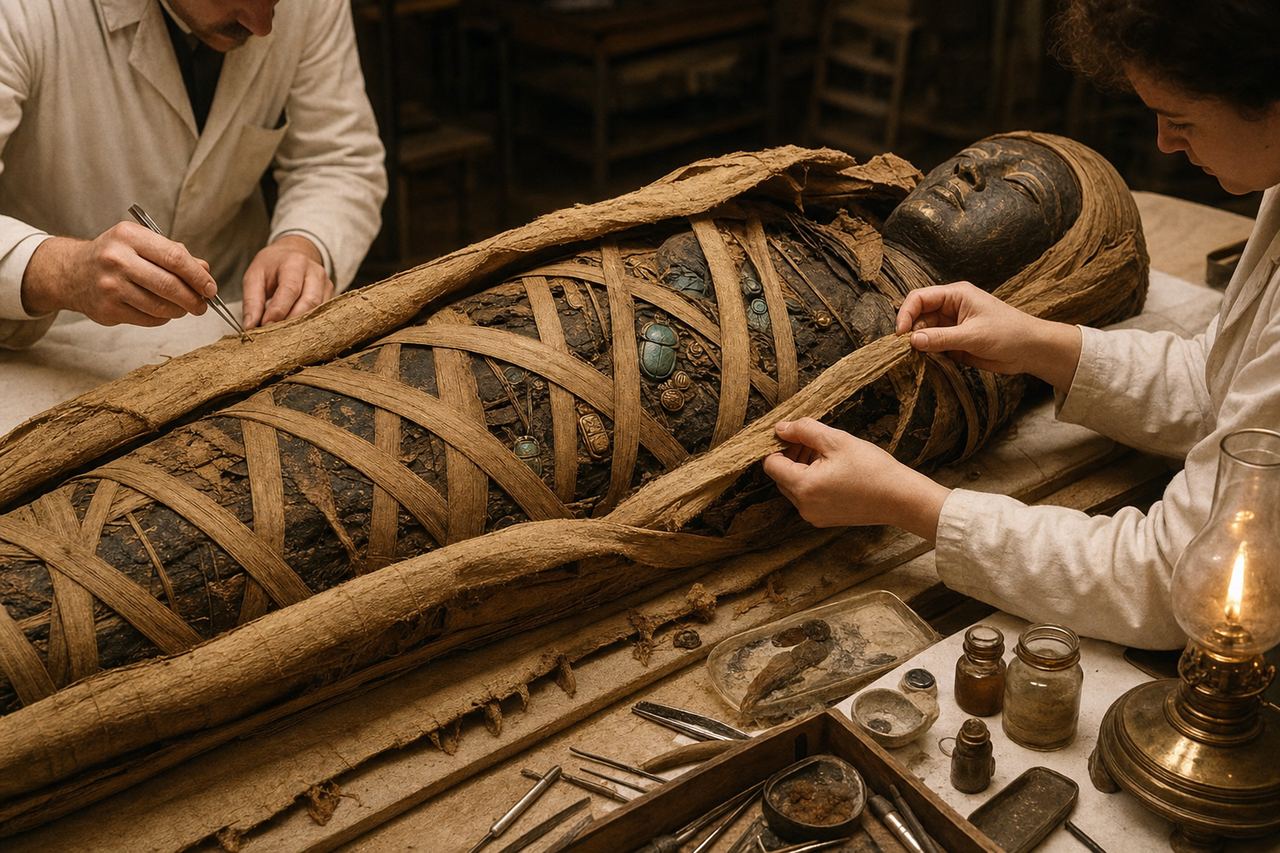
Days 1–7: The body was purified. The brain was removed through the left nostril using iron hooks and discarded — the Egyptians believed thought occurred in the heart.
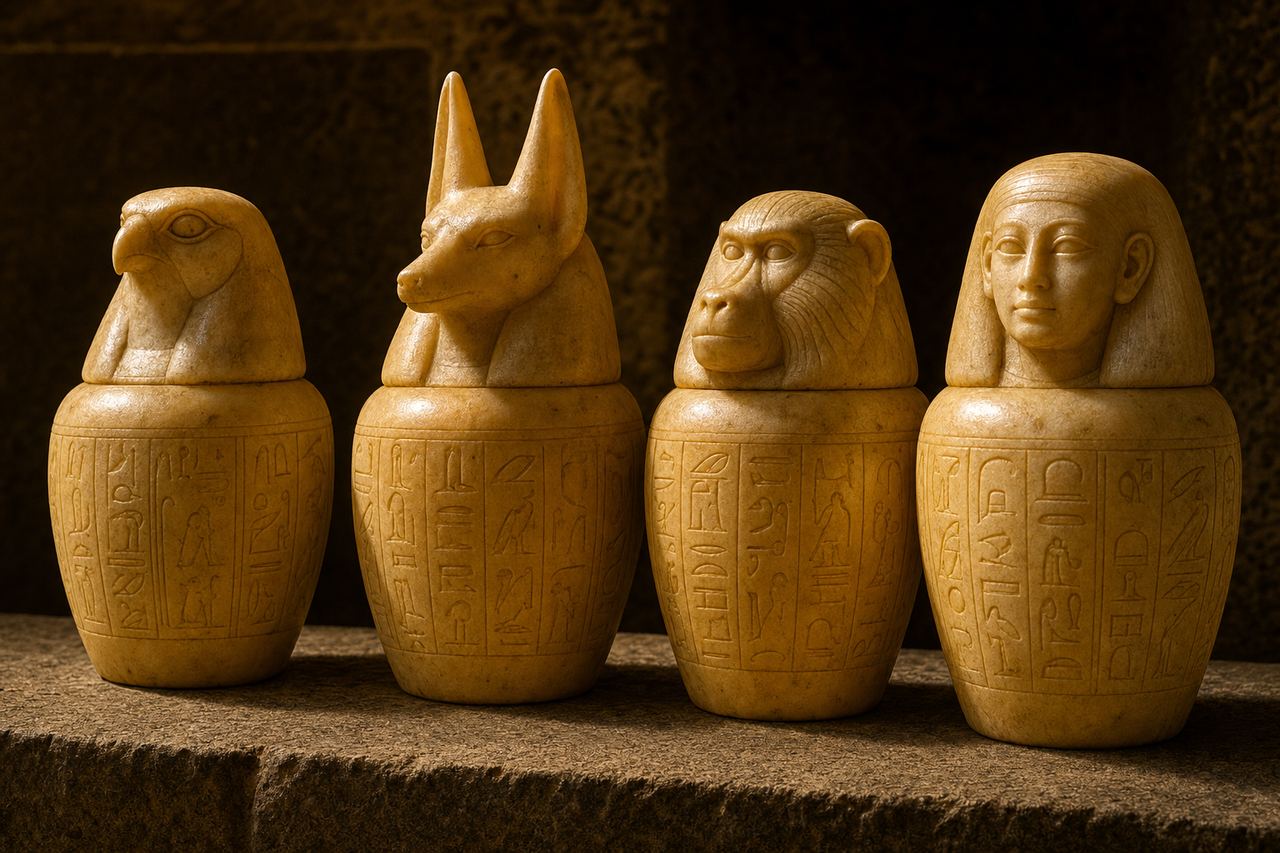
Days 6–7: The liver, lungs, stomach, and intestines were removed, dried with natron, and placed in canopic jars under the protection of the Four Sons of Horus. The heart was left in the body.
Days 8–47: The body was covered with natron salt and dried for 40 days.
Days 48–70: The body was washed, anointed with oils, stuffed to restore shape, and wrapped in hundreds of metres of linen. Amulets and spells from the Book of the Dead were placed between every layer.
The Funeral Mask
For royalty, a mask was placed over the head and shoulders — gilded cartonnage or, for pharaohs, solid gold. It served as a substitute face should the mummy be damaged, allowing the soul to recognise its body.
Natron and the Canopic Jars
Natron — a naturally occurring salt mixture harvested from dry lake beds at Wadi Natrun — was the chemical engine of mummification. It is primarily sodium carbonate and sodium bicarbonate, with smaller amounts of chloride and sulphate salts. The embalmers packed it directly into the body cavity after organ removal, and piled it in heaps over the exterior of the corpse. Over 40 days it drew moisture out of the tissues, collapsing the cells and halting bacterial decay before it could take hold. The result was not simply dryness — natron actively changed the chemical structure of the remaining tissue, hardening it against future decomposition.
The extracted organs — liver, lungs, stomach, intestines — were dried separately with natron and then placed in four canopic jars, each protected by one of the Four Sons of Horus. Imsety (human-headed) guarded the liver; Hapy (baboon-headed) the lungs; Duamutef (jackal-headed) the stomach; Qebehsenuef (falcon-headed) the intestines. By the New Kingdom, the organs were sometimes wrapped in linen packets and returned to the body cavity rather than stored in separate jars, though the jars remained as ritual objects regardless.
Mummification on a Budget
Herodotus, writing in the 5th century BCE, described at least three distinct price tiers for mummification. The most expensive — reserved for royalty and the wealthy — involved full organ removal, 40 days of natron drying, linen wrapping with amulets layered between each bandage, and a painted coffin. The middle tier skipped the finest linens and fewer amulets. The cheapest involved injecting an oil or dissolving agent into the body through the rectum to liquefy the organs, which were then drained out, and drying the remainder — no incision, no canopic jars, no mask.
Below even this were those who received no professional mummification at all. Simple desert burials in the sand — the body wrapped in a mat and interred in a shallow pit — produced natural mummies through desiccation alone. Some of the oldest preserved human remains from Egypt, predating the pharaohs by thousands of years, survive precisely because of this accidental method. The dry climate did what no embalmer was needed to do. The pyramids and golden masks were elaborations on a process the desert had always performed for free.
Frequently Asked Questions
How long did mummification take?
The full mummification process took 70 days. This figure matched the 70-day period during which the star Sirius disappeared below the horizon — a celestial event of deep religious significance to the Egyptians. The first days involved organ removal and purification; the middle 40 days were given to drying the body with natron salt; the final days to wrapping, anointing, and the funeral rituals.
What happened to the brain during mummification?
The brain was removed through the left nostril using a long metal hook, which broke up the tissue so it could be drained out. The Egyptians considered the brain unimportant — they believed thought and emotion originated in the heart, which was always left inside the body. The extracted brain was discarded, unlike the other organs, which were carefully preserved in canopic jars.
What is natron?
Natron is a naturally occurring salt mixture found in dry lake beds in Egypt, particularly at Wadi Natrun. It is composed primarily of sodium carbonate and sodium bicarbonate. During mummification it was packed both inside the body cavity and piled over the exterior to draw out moisture, halt bacterial decay, and preserve the tissues over a 40-day drying period.
Could poor Egyptians be mummified?
Yes, but the process was drastically simplified. Herodotus described at least three price tiers. The cheapest involved injecting a dissolving liquid into the body, draining the liquefied organs, and drying the body with natron — no incisions, no canopic jars, no linen amulets. Poorer Egyptians might also be buried in simple desert graves, where dry sand naturally preserved the body without any professional intervention at all.