The Most Powerful Pharaoh
Ramesses II reigned from approximately 1279 to 1213 BCE — 66 years — and outlived twelve of his own sons. He built more monuments and fathered more children than almost any other pharaoh. By the time he died, aged around 90, he had become a god in his own lifetime.
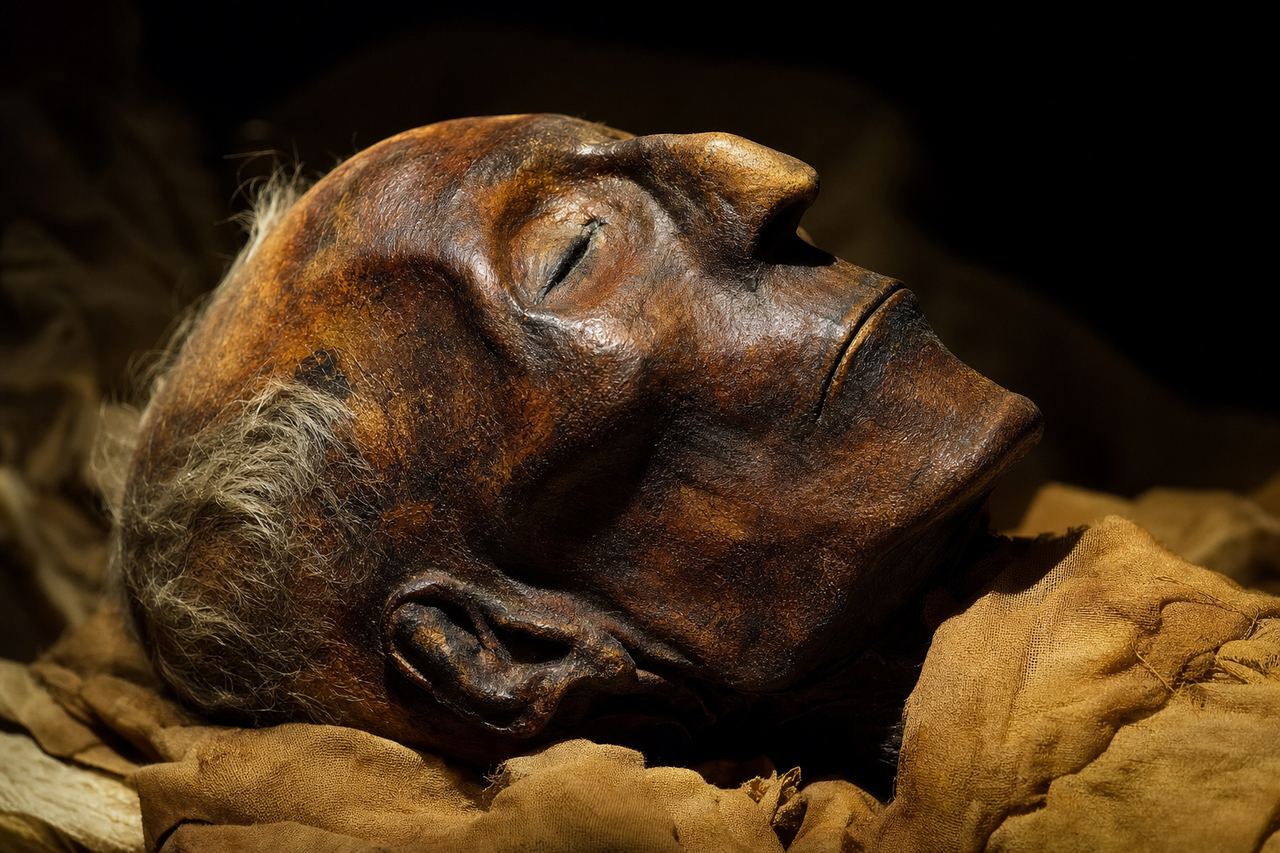
His Red Hair
One of the most striking details about Ramesses II's mummy is his hair — reddish-blond, still visible in strands. Ancient Egyptians associated red hair with the god Set, lord of chaos and desert.
The Passport
In 1976, France requested the mummy for urgent conservation work on a fungal infection. Ramesses II flew to Paris on an Egyptian Airlines flight. Egyptian law requires a valid passport for any "citizen" leaving the country. The government issued one. Under occupation: King (deceased). He was met at Paris-Le Bourget airport with full honours of a head of state.
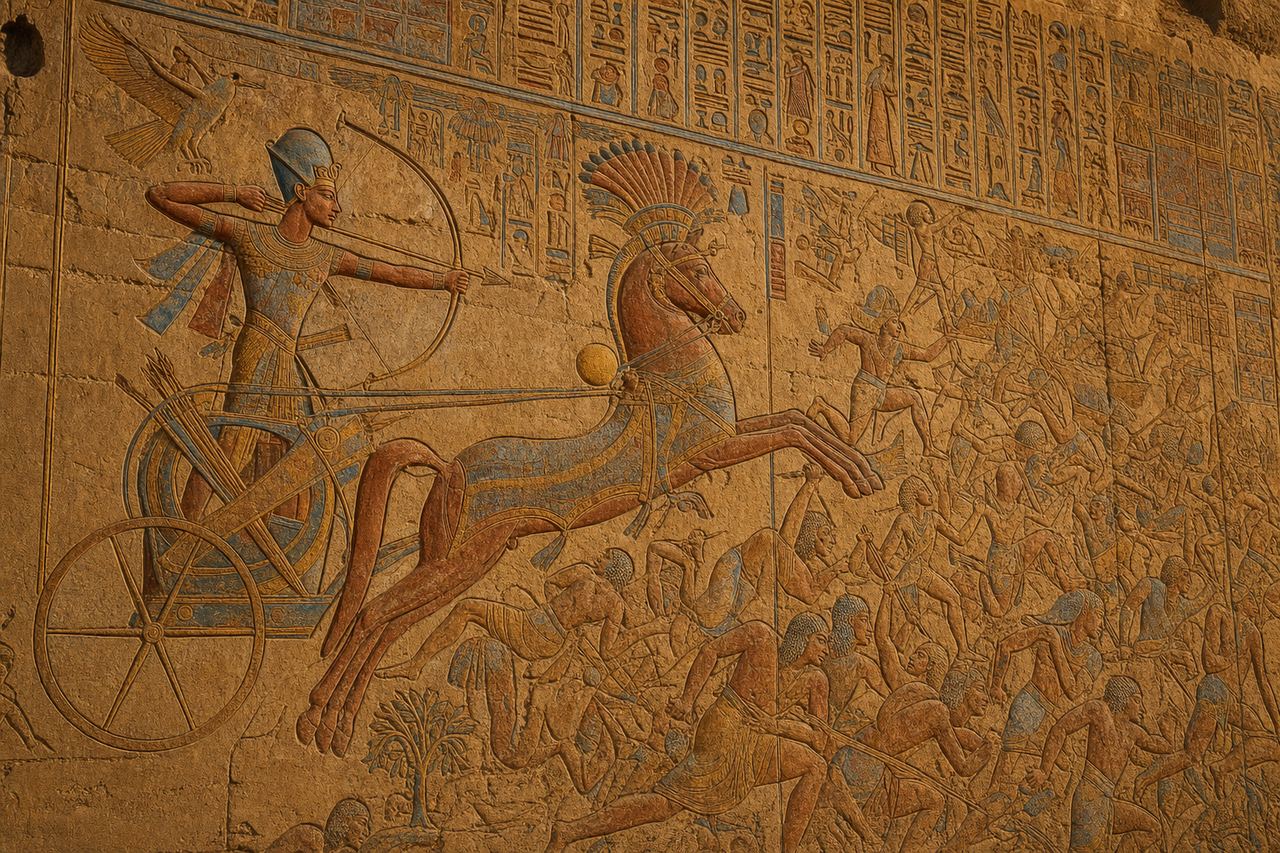
"His Majesty was received with all honours due to his rank as a great sovereign."— Egyptian government, 1976
What the Scans Revealed
In Paris, scientists did more than treat the fungal infection — they read the mummy like a medical file. X-rays and later CT scans disclosed a life lived in extremity. His spine shows severe arthritis that would have forced him into a pronounced stoop in old age. His arteries were hardened throughout — atherosclerosis, the same condition that kills modern men of sedentary, high-fat diet — suggesting the royal diet of meat and bread took its toll over nine decades. Dental abscesses had eaten into his jawbone in several places; the pain would have been constant. His hair, examined under microscope, was found to have been dyed after death with henna — a reddish pigment the embalmers applied to restore its original colour. The underlying strands beneath the dye were white.
The mummy is also notable for what it shows about his build in life: tall for the period, with a long narrow skull and a sharply aquiline nose that matches precisely the colossal statues he erected of himself across Egypt — from Abu Simbel to the Ramesseum to Luxor temple. He was not flattering himself in stone. He was accurate.
Outliving His Sons
Ramesses II fathered an estimated 100 children by his principal wives and secondary wives. His favourite queen, Nefertari — celebrated in the smaller of the two Abu Simbel temples — died before him; so did his next great wife, Isetnofret. Twelve of his sons predeceased him. His 13th son, Merneptah, finally took the throne — already an old man himself. The Merneptah Stele, dated to around 1208 BCE, contains the earliest known written reference to Israel as a people, a detail that has fuelled the Exodus debate ever since. Ramesses himself left no such record — and the silence of Egyptian records about any Hebrew departure or plagues remains the central problem for those who identify him as the biblical pharaoh.
Frequently Asked Questions
Where is Ramesses II's mummy today?
Ramesses II's mummy is displayed in the Royal Mummies Hall at the National Museum of Egyptian Civilization (NMEC) in Cairo, where it was transferred in a ceremonial parade of pharaohs in April 2021. It had previously been housed at the Egyptian Museum in Tahrir Square for decades after its return from Paris in 1976.
How old was Ramesses II when he died?
Ramesses II is estimated to have died at around 90 years of age, after a reign of approximately 66 years. He outlived twelve of his sons and saw at least three generations of his descendants. His 13th son, Merneptah, was already elderly when he finally inherited the throne.
What does Ramesses II's mummy look like?
The mummy shows a powerfully built man with a long, narrow skull and a prominent aquiline nose that matches his stone portraits exactly. His hair — still present in strands — is reddish-blond from henna applied by embalmers after death; the underlying strands are white. CT scans have revealed severe spinal arthritis, hardened arteries, and multiple dental abscesses that would have caused him chronic pain in his final years.
Was Ramesses the pharaoh of the Exodus?
Ramesses II is the most popular candidate in popular culture, partly because his capital Pi-Ramesses in the Nile Delta matches the biblical description of a city built by enslaved labourers. However, no contemporary Egyptian record of a mass exodus exists, and mainstream Egyptology regards the identification as unproven. Some scholars propose earlier pharaohs; others question whether the Exodus occurred as a single historical event at all.