The Robbers Who Knew
In the late 1870s, dealers in Luxor began selling ancient papyri and small artefacts of unmistakably royal provenance. The objects were genuine — but no known tomb had been opened. Gaston Maspero, newly appointed Director of the Egyptian Antiquities Service, began investigating. The trail led to a family: the Abd el-Rassoul brothers of Gurna, a village of tomb robbers whose ancestors had picked the Valley of the Kings clean for generations.
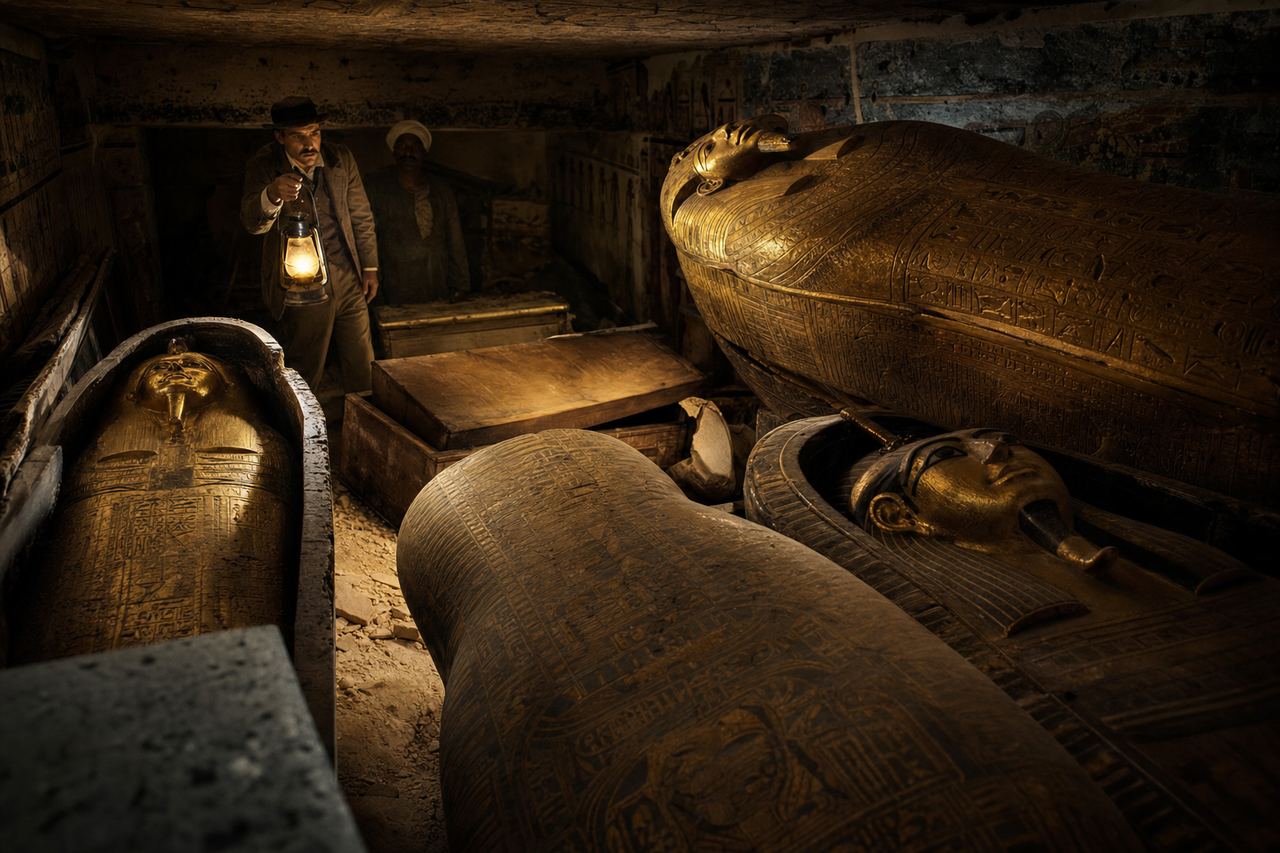
After years of denial, one brother cracked under pressure. In June 1881, he led Egyptian officials to a narrow shaft cut into the cliff face at Deir el-Bahari, high above the Nile valley at Luxor. At the bottom, 11 metres down, was a corridor 60 metres long.
Inside it were the mummies of at least 40 kings, queens, and high priests of ancient Egypt — hidden there by ancient priests around 1000 BCE to protect them from the tomb robbers who were stripping the Valley of the Kings bare.
What Was Inside
Egyptologist Emile Brugsch was lowered into the shaft on 5 July 1881. What he saw by candlelight left him speechless: coffin after coffin, stacked three deep, with royal names he recognised from the history of ancient Egypt. Ramesses II. Seti I. Thutmose III. Ahmose I, who expelled the Hyksos and founded the New Kingdom. Seqenenre Tao II, whose skull bore horrific axe wounds from a battlefield death 500 years before Christ.
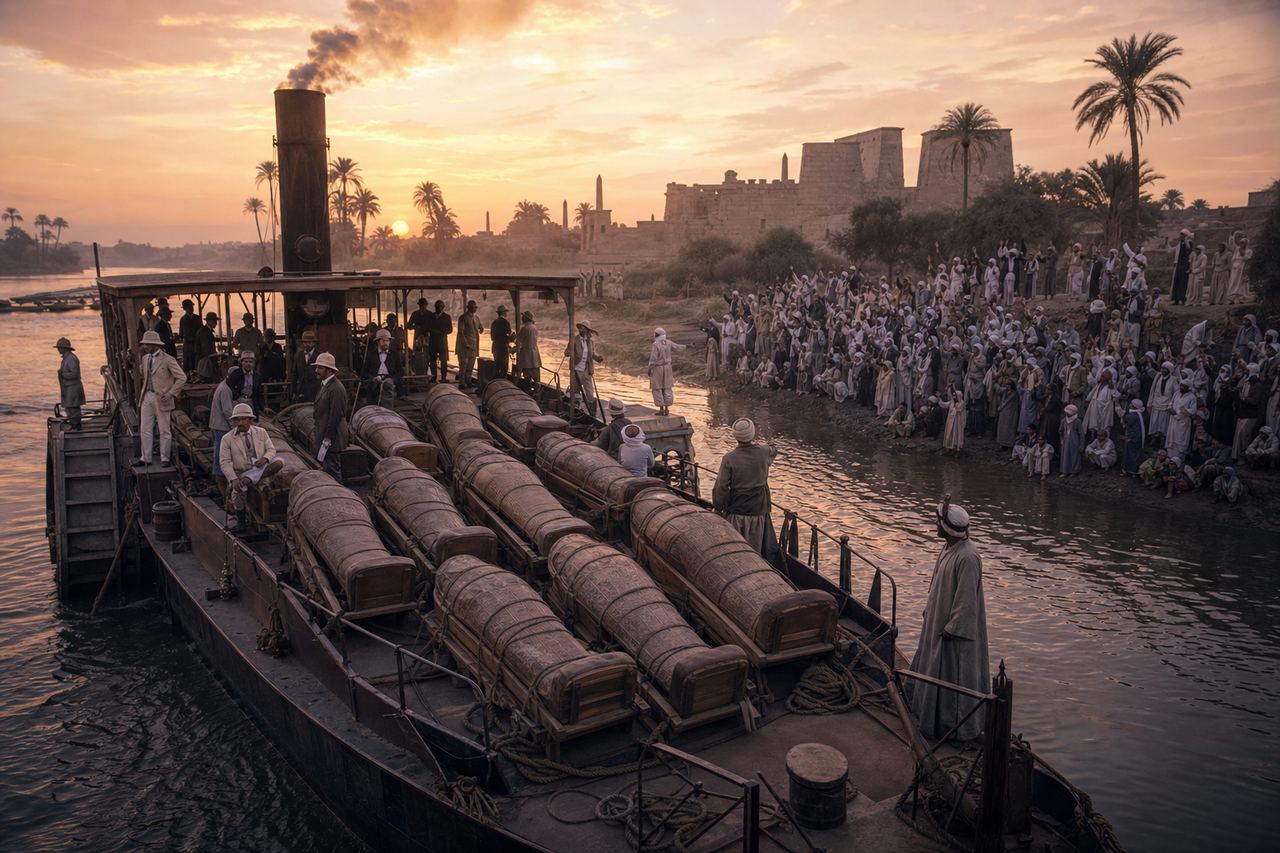
Brugsch spent 48 hours in the shaft, cataloguing the finds by candlelight, before the mummies were carried out and loaded onto a government steamboat bound for Cairo.
"As the steamer moved north, Egyptian fellahin who had gathered on the banks began wailing and throwing dust on their heads — the traditional gesture of mourning. The pharaohs were going home."— Gaston Maspero, 1881
Why They Were Hidden
The priests of Amun at Karnak had been systematically collecting the royal mummies from their robbed and damaged tombs in the Valley of the Kings during the Third Intermediate Period, around 1000 BCE. They rewrapped the mummies, relabelled them, and hid them in the Deir el-Bahari cache to prevent further violation.
The cache also contained the mummies of the priests themselves — and vast quantities of funerary equipment stripped from the original tombs. It was a rescue mission conducted 3,000 years ago, which preserved the pharaohs for us to find today.
A Second Cache
In 1898, archaeologist Victor Loret discovered a second royal cache in tomb KV35 in the Valley of the Kings — the tomb of Amenhotep II. Inside were a further 13 royal mummies, including Amenhotep III (probably Tutankhamun's grandfather), Thutmose IV, and two unidentified women known as "the Elder Lady" and "the Younger Lady."
DNA testing in 2010 identified the Elder Lady as Queen Tiye, the powerful wife of Amenhotep III — and the Younger Lady as the biological mother of Tutankhamun. The royal family was reassembling, one DNA sample at a time. Both caches together account for the survival of more royal mummies than all other Egyptian sites combined — a record of preservation as unlikely as it is complete.
Frequently Asked Questions
What is the Royal Cache?
The Royal Cache refers to tomb DB320 at Deir el-Bahari, a cliff shaft discovered in 1881 that contained the mummies of at least 40 pharaohs, queens, and high priests of ancient Egypt. The mummies had been gathered from their robbed tombs in the Valley of the Kings by ancient priests around 1000 BCE and hidden to prevent further desecration. It is the largest single collection of royal mummies ever found.
Where can the Royal Cache mummies be seen today?
The mummies from DB320 are displayed in the Royal Mummies Hall at the National Museum of Egyptian Civilization (NMEC) in Cairo. In April 2021, Egypt staged a ceremonial Pharaohs' Golden Parade, transporting the mummies through the city's streets in a procession watched by millions. The hall presents each mummy in a climate-controlled case with full identity and historical context.
Why were the mummies hidden?
By around 1000 BCE, tomb robbers had stripped most of the royal tombs in the Valley of the Kings — sometimes within years of the original burial. The priests of Amun at Karnak systematically collected the damaged royal mummies, rewrapped them, relabelled them, and concealed them in the Deir el-Bahari shaft to prevent further violation. Their discretion preserved the pharaohs for nearly 3,000 years.