Found by Peat Workers
In May 1897, two peat workers cutting near the village of Yde in the Dutch province of Drenthe fled their worksite in terror, reporting that they had found a devil in the peat — a leathery, red-haired creature with a terrifying grimace. When investigators arrived, they found the partially desiccated body of a young woman, approximately 16 years old, who had been in the bog for roughly 2,000 years.
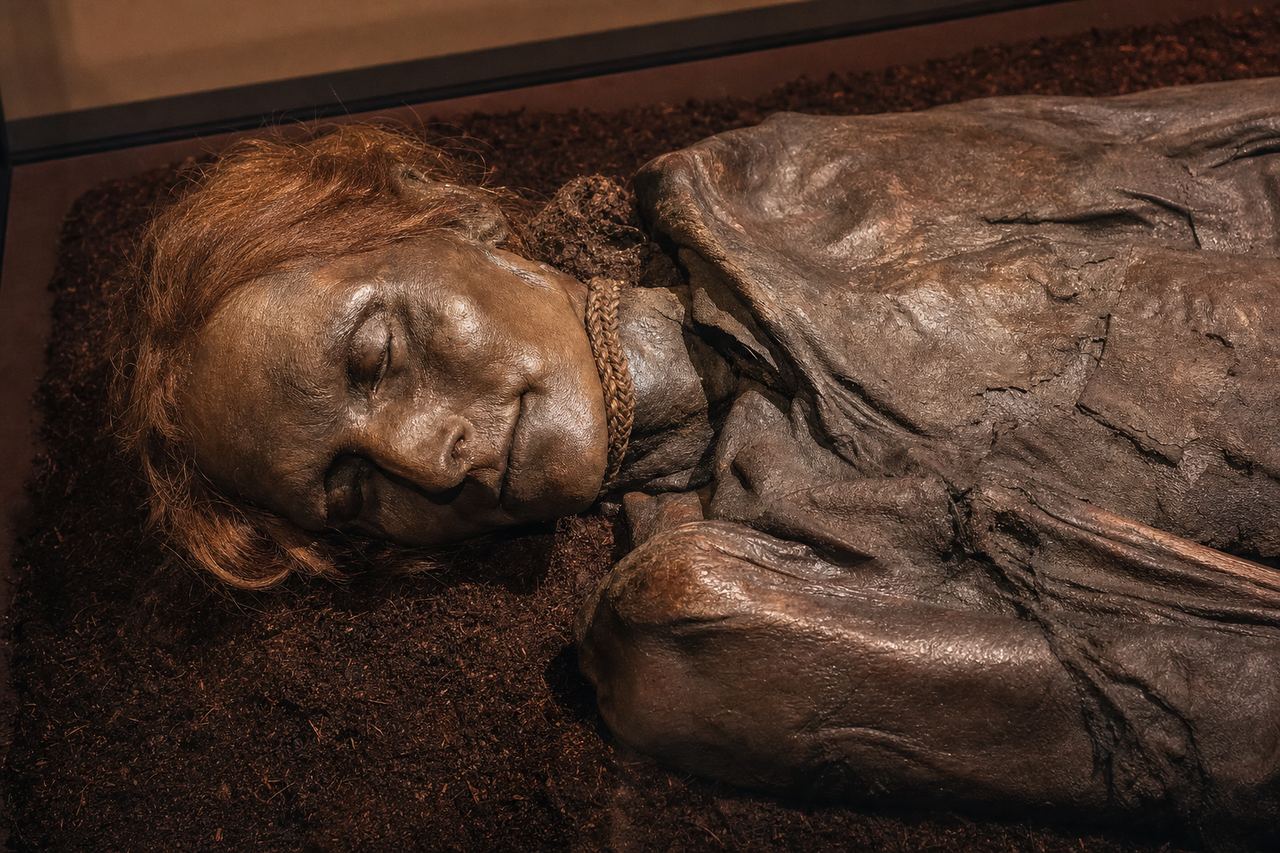
She was given the name "the Yde Girl" after the village. She is one of the most studied bog bodies in Europe and the subject of one of the most famous forensic facial reconstructions ever made.
Who She Was
The Yde Girl was approximately 16 years old at her death, around 54 BCE, in the late Iron Age. She stood about 1.40 metres tall — short even for the period. She had red hair, approximately half of which had been shaved or cut off before or after her death.
Most significantly, the Yde Girl had severe scoliosis — a curvature of the spine that, in her case, would have caused a pronounced lean to one side and difficulty walking. Whether her disability was the reason for her sacrifice — some researchers have proposed that Iron Age societies sacrificed people seen as "marked" by the gods — or entirely coincidental remains unknown.
How She Died
A narrow band of woollen cloth — a half-woven ribbon — was wound three times around her neck and tied in a complex knot. She was strangled. Before or after death, her left collar bone was fractured. She was stabbed in the neck. Like Lindow Man and Tollund Man, she appears to have been killed in multiple ways — the triple death that characterises so many bog body sacrifices across northern Europe.
"She was young. She had a disability. She had her hair shaved. She was killed three times. Something about her was considered exceptional — either exceptionally valuable, or exceptionally dangerous."— Wijnand van der Sanden, bog body archaeologist
The Facial Reconstruction
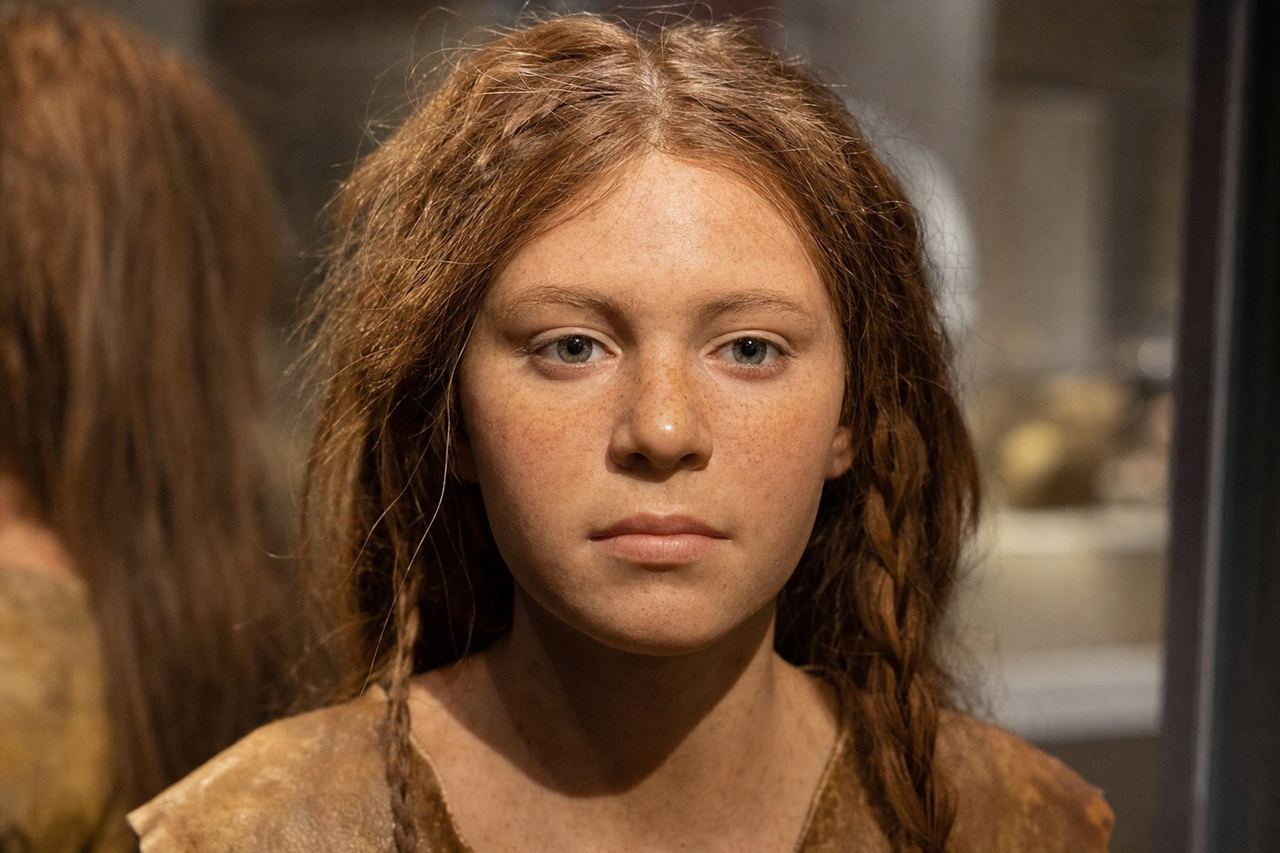
In 1992, forensic artist Richard Neave of Manchester University was given the Yde Girl's skull and commissioned to produce a facial reconstruction. Using the standard technique of building clay over a cast of the skull according to known tissue depth measurements, Neave produced a face that has become one of the most reproduced images in archaeology: a young woman with high cheekbones, a slightly asymmetric face, and an expression of quiet alertness.
The reconstruction was displayed at the Drents Museum with a photograph of the original bog body alongside it — and the contrast between the leathery, grimacing mummy and the living face the reconstruction imagined was deeply affecting for museum visitors. She went from a "devil in the peat" to a person.
What the Shaved Hair Means
The partial shaving of the Yde Girl's hair is a feature shared by several other bog bodies. Interpretations vary: ritual humiliation before sacrifice; symbolic removal of identity; a mark distinguishing the sacrificial victim from ordinary people; or post-mortem disturbance during the burial process.
Caesar and Tacitus both describe ritual practices among Germanic and Celtic tribes involving the cutting of hair as a mark of slavery, punishment, or religious status. The Yde Girl's half-shaved head may be a physical record of whatever ritual status she occupied in her community's cosmology — set apart, marked, and offered.
Frequently Asked Questions
Where was Yde Girl found and where can she be seen today?
Yde Girl was discovered in 1897 in a peat bog near the village of Yde in the Netherlands. Her preserved remains are now displayed at the Drents Museum in Assen, Netherlands, where visitors can also see the 1992 facial reconstruction that brought her appearance back to life after more than two thousand years.
How did Yde Girl die?
She was killed by garroting — a cord was tightened around her neck — and she also suffered a stab wound to her left shoulder. The combination of methods suggests her death was deliberate and likely ritualistic rather than the result of ordinary violence or accident.
Why was half of Yde Girl's head shaved before she died?
The reason is not known with certainty, but researchers have connected it to the scoliosis found in her spine. In some Iron Age societies, visible physical difference could mark a person for ritual sacrifice, and the partial shaving may have been a ceremonial act performed as part of that process rather than a punishment or coincidence.
How old was Yde Girl and when did she live?
She was approximately 16 years old at the time of her death, which is dated to around 54 BCE, placing her in the late Iron Age. Her young age and the careful manner of her killing suggest she may have been selected for sacrifice rather than executed as a criminal.