Found in Cheshire
On 1 August 1984, workers at Lindow Moss peat bog near Wilmslow, Cheshire, England, noticed something unusual on the automated peat-cutting conveyor belt. It was a human foot — leathery, brown, and preserved. They called the police.
Two years earlier, at the same site, workers had found a preserved human skull — which prompted a local man to confess to murdering his wife decades previously. That skull turned out to be around 1,700 years old. The police, mindful of this earlier mix-up, this time called archaeologists immediately.
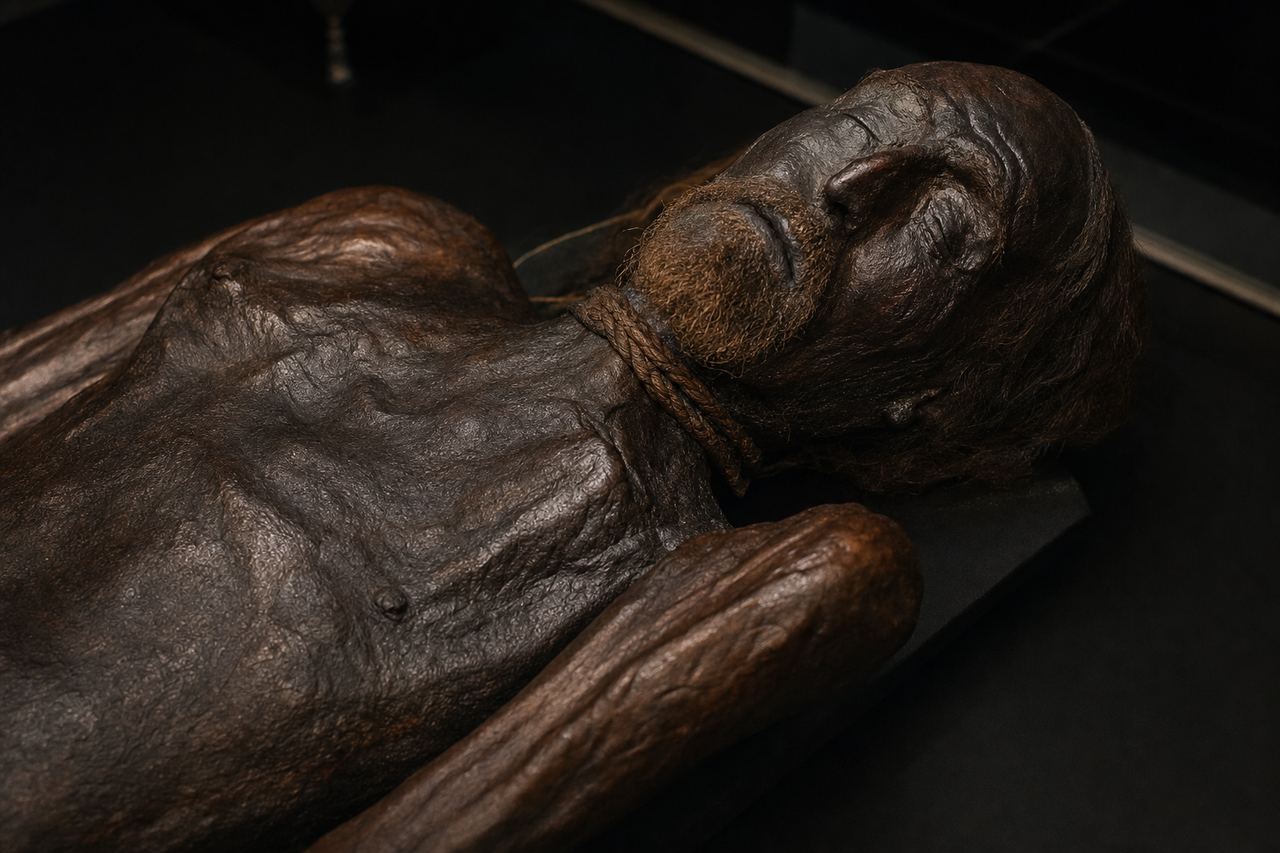
What they found was Lindow Man — officially designated Lindow II — the most extensively studied bog body ever found in Britain, and one of the most scientifically important Iron Age human remains in the world.
The Triple Death
Forensic analysis of Lindow Man revealed that he died in three ways, simultaneously or in rapid sequence — what scholars now call the "triple death," a pattern that appears to hold ritual significance in Celtic and Iron Age belief systems.
The blow: He was struck twice on the top of the skull with a narrow-bladed instrument, probably a small axe. The blows were delivered from above and behind, and they fractured his skull without immediately killing him.
The garroting: A cord — the narrow ligature mark is still visible on his throat — was twisted around his neck using a stick or rod, breaking the third and fourth cervical vertebrae and causing death by compression of the carotid arteries and spinal cord damage simultaneously.
The throat cut: His throat was cut — a sharp incision, likely with a knife. This would have drained the blood rapidly, serving both a practical (death-hastening) and possibly ritual (blood offering) function.
"Three methods of killing, all applied at once or in rapid sequence. This was not execution. This was ceremony." — Don Brothwell, forensic anthropologist, British Museum
The Druid Connection
The combination of methods — air (the blow), earth (the garroting, breaking the neck), and water (the throat cut releasing blood to flow) — mirrors descriptions in early Irish and Welsh mythology of ritual threefold death as the appropriate end for a king or sacred victim. Julius Caesar and other Roman writers described the Druids as conducting human sacrifices; this, many archaeologists believe, is what they described.
The mistletoe pollen found in Lindow Man's gut adds weight to the Druidic interpretation. Mistletoe was the sacred plant of the Druids — used in their most important ceremonies, gathered with a golden sickle. Finding it in a sacrificial victim's digestive system suggests his final meal was deliberately connected to Druidic ritual.
Who He Was
Lindow Man was between 25 and 30 years old at his death, around 300 BCE, during the late Iron Age in Britain. He was well-built — approximately 1.68 metres tall and 60–65 kilograms. His hands showed no signs of heavy manual labour; his fingernails were trimmed and well-maintained.
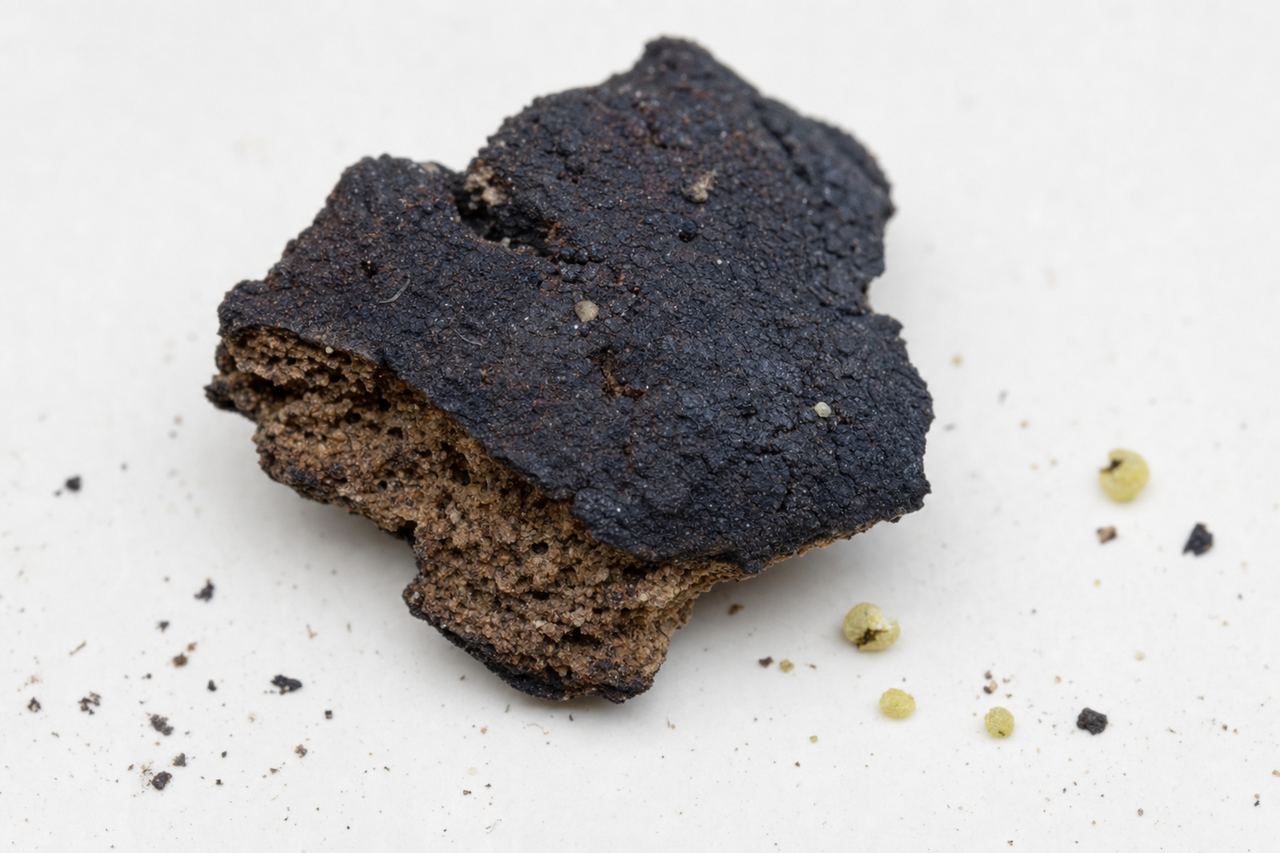
His last meal was a griddle cake — a type of flatbread cooked on a hot stone — made from wheat and barley with traces of mistletoe pollen. It was eaten between 12 and 24 hours before his death. Whether it was a ritual last meal or simply his ordinary breakfast, it was the last thing he tasted.
The Preservation
Lindow Moss is an acidic raised bog — the same chemistry that preserved Tollund Man in Denmark preserved Lindow Man in England. The sphagnum moss creates sphagnan, a carbohydrate that binds to nitrogen and inhibits the bacteria that cause decomposition. The cold, oxygen-free water does the rest.
Lindow Man's skin is preserved as dark brown leather. His hair and beard — reddish-brown, trimmed — are intact. His internal organs are shrunken but present. His brain, though compressed, survives. The peat transformed him, but it kept him.
The Companion: Lindow III
The peat workers who found Lindow Man in 1984 were not done. In 1987, a third set of remains was found at Lindow Moss — a further fragment of a body that may represent either another individual (Lindow III) or additional parts of Lindow Man himself. The question of whether these fragments represent one person or two remains unresolved.
The first find at Lindow Moss was Lindow I — the skull found in 1983 that led to the false murder confession. Lindow Moss has now yielded three different bodies from three different time periods. The bog was, it seems, used as a place of deposition across many centuries.
Where He Is Today
Lindow Man is displayed in Room 50 of the British Museum in London, in a specially designed display case that maintains a controlled atmosphere to prevent further deterioration. He is one of the most popular exhibits in the museum, and one of the most viewed Iron Age human remains in the world. The reconstructed face, displayed alongside him, shows a young man with the manicured beard and composed features of someone who understood what was happening to him — and accepted it.
Frequently Asked Questions
Where was Lindow Man found and where can he be seen today?
Lindow Man was discovered in 1984 in Lindow Moss, a peat bog near Wilmslow in Cheshire, England, by workers at a commercial peat-cutting operation. His remarkably preserved remains are now on permanent display at the British Museum in London, where visitors can view the flattened but largely intact upper body.
How did Lindow Man die?
Lindow Man suffered what researchers call a "triple death" — he was struck on the head at least twice, garotted with a sinew cord that broke his neck, and had his throat cut. This combination of killing methods, applied around 300 BCE, is widely interpreted as a ritualistic sacrifice rather than a simple execution or murder.
What did Lindow Man eat before he died?
Analysis of his stomach contents revealed that his last meal was a flatbread made from wheat and barley, charred on the outside in a way consistent with cooking directly on embers. Pollen from mistletoe was also detected, a plant held sacred by Iron Age druids, which has strengthened the theory that his death formed part of a religious ceremony.
How old was Lindow Man when he died, and what do his remains reveal about his life?
Lindow Man was between 25 and 30 years old at the time of his death. Physical examination of his remains shows well-maintained fingernails and no signs of heavy manual labour, suggesting he held a relatively high social status in his community rather than working as a farmer or craftsman.