The Discovery
In February 2003, peat-cutting machinery in County Meath, Ireland sliced through an ancient body — the torso and head were found, but the lower body had been destroyed by the machine. What remained revealed a remarkable individual.
The Hair Gel
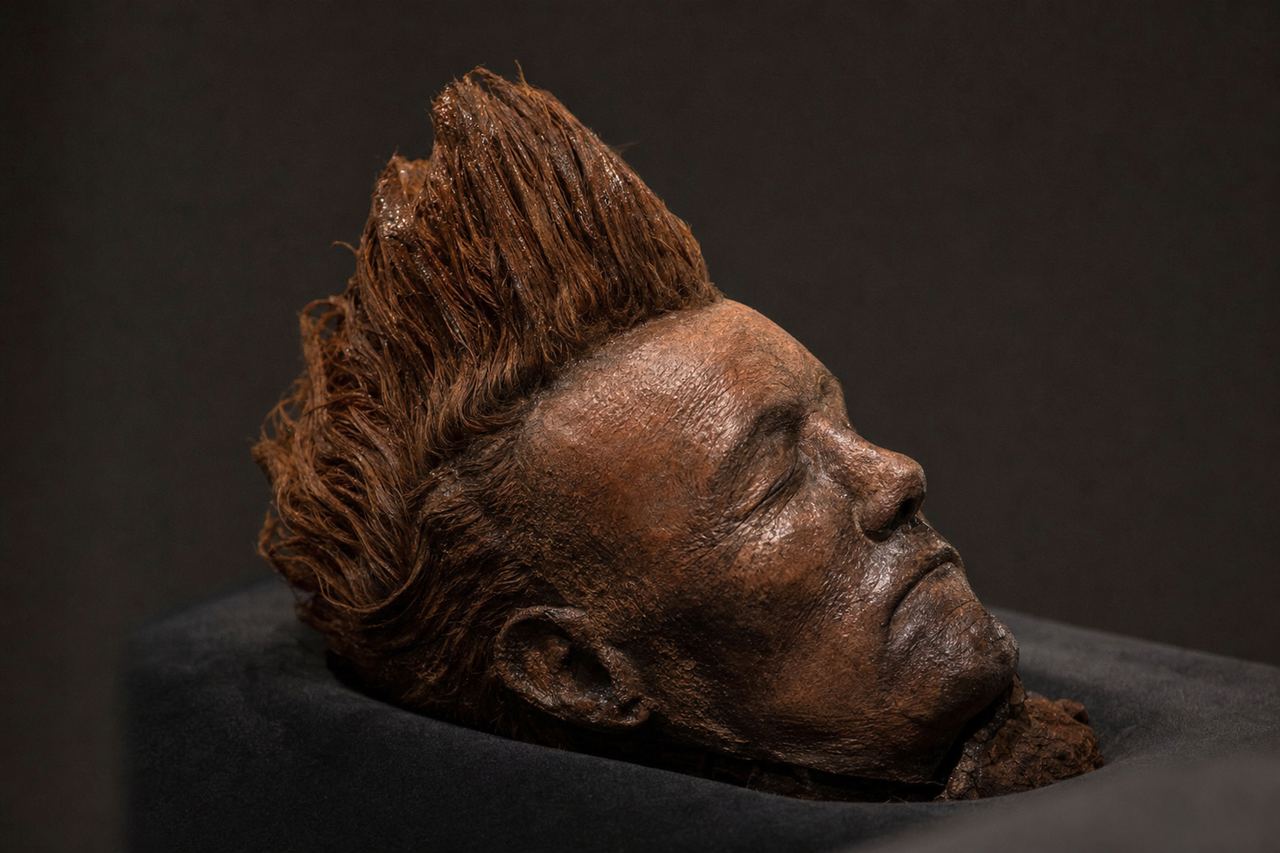
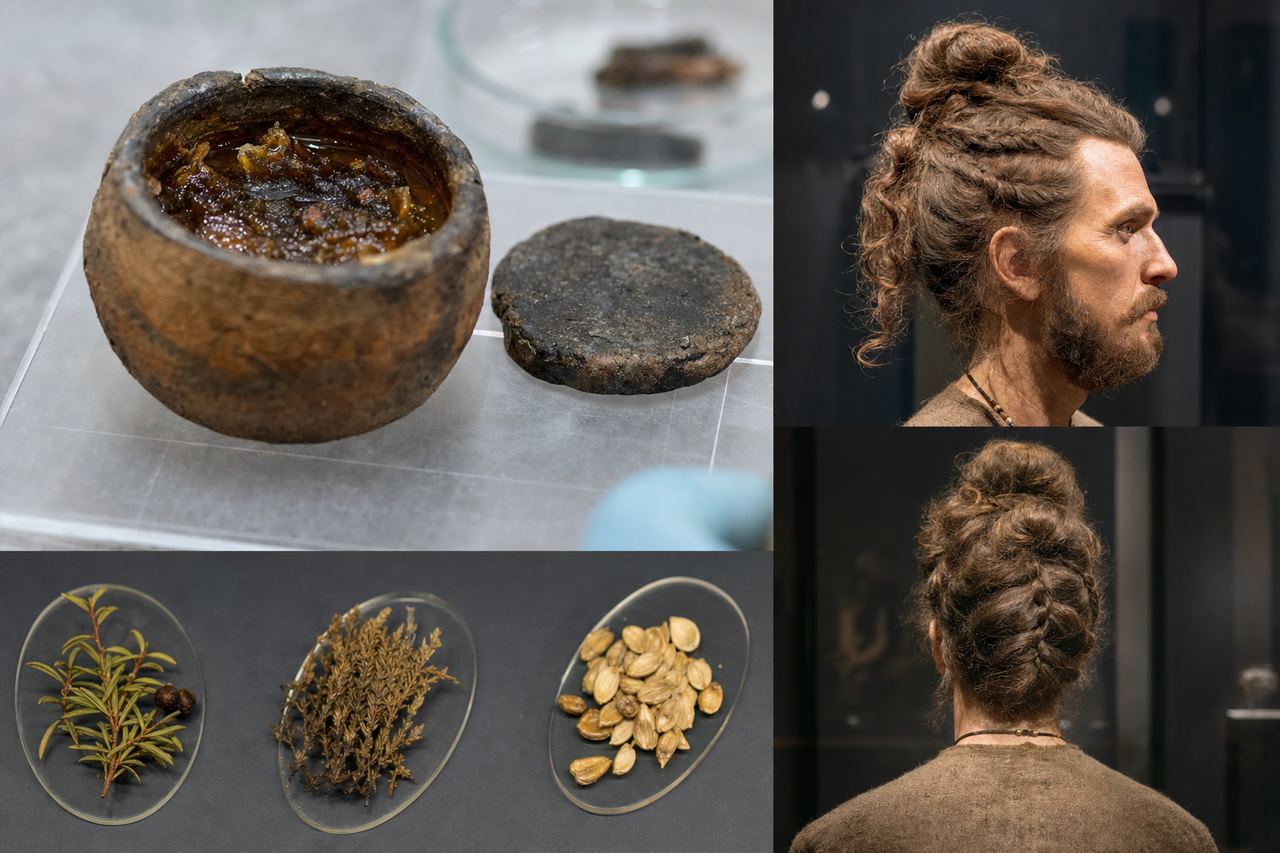
Clonycavan Man's hair was styled into a tall mohawk-like arrangement and held in place with a resinous substance. Chemical analysis identified it as a plant-oil resin mixed with pine resin — probably imported from France or Spain. He was using a high-status imported cosmetic product 2,350 years ago. This identifies him as a person of some wealth and status.
His Death
Despite his evident status, Clonycavan Man died violently. His skull was struck three times with a sharp blade, probably an axe. His nose had also been broken, possibly perimortem. He was between 20 and 25 years old and relatively short at about 1.57 metres. He died around 350 BCE during the Iron Age.
The Hair — Oldest Known Hair Product in History
The most startling thing about Clonycavan Man is not how he died but how he looked before it happened. His dark hair was swept upward and fixed in place with a gel compound that chemical analysis identified as vegetable plant oil blended with resin from Pinus pinaster — a species native to the Atlantic coast of France and the Iberian Peninsula. The substance had been imported more than a thousand miles to Ireland, then used as a cosmetic.
This makes it the oldest identified hair-styling product anywhere in the world. The effort involved — acquiring an exotic import, using it to shape an elaborate hairstyle — speaks directly to Clonycavan Man's social standing. He was not a labourer. Researchers have also noted that his mohawk-like styling added height to a man who stood only about 1.57 metres tall. Whether vanity or status-signalling, the intention is unmistakable across 2,350 years.
The Violence — Overkill as Ritual
His death was not quick and it was not accidental. Clonycavan Man received at least three sharp-force blows to the head with what forensic analysts believe was a heavy-bladed axe or similar weapon. The first blow fractured the skull; subsequent blows were delivered with force that opened the cranium. He was also struck across the torso — a disembowelling blow that cut through the abdomen. His nose had been broken, possibly in the same attack.
The pattern of injuries fits what archaeologists call "overkill" — a level of violence that goes beyond what is needed to kill someone and enters the territory of ritual. Three blows to the head, disembowelment, and placement in a bog near a territorial boundary are all consistent with the sacrificial killing documented across Iron Age Europe. Clonycavan Man was not disposed of. He was deposited.
The "Bog King" Theory and What It Means
Irish bog bodies are found with unusual regularity near the boundaries of ancient tribal territories — the divisions between kingdoms called tuatha. Clonycavan Man was found close to such a boundary in County Meath. Old Croghan Man, found the same year, was found near another. This pattern has led some archaeologists to propose that these men were "kings" — or king-candidates — killed in fertility rites meant to ensure the land's productivity.
In early Irish mythology and law, the king's bond with the land was literal and physical. A failed king meant failed harvests. A ritual killing at the territorial edge, with the body given to the bog, may have been understood as a contract with the earth itself. The imported hair gel, the careful styling, the evident status of the man — these suggest someone who understood his own importance, even at the end.
Conservation and Where He Is Now
Because the peat-cutting machine destroyed his lower body before the find was recognised, only Clonycavan Man's head, upper torso, and hair survived. The bottom half was never recovered. What remained was handed to the National Museum of Ireland in Dublin, where conservators stabilised the tissue through a careful freeze-drying process.
He has been displayed at the museum — sometimes alongside Old Croghan Man — as part of exhibitions on Irish bog bodies. The two men, found 25 miles apart and in the same year, make a striking pair: one broad and tall, one slight and vain, both killed with the same deliberate ritual ferocity in the same Iron Age landscape.
Frequently Asked Questions
Where was Clonycavan Man found?
Clonycavan Man was found in February 2003 in a bog in County Meath, Ireland. A peat-cutting machine sliced through the body, destroying the lower half entirely. The recovered torso, head, and hair are now held at the National Museum of Ireland in Dublin.
What is significant about Clonycavan Man's hair?
His hair was styled into a raised mohawk-like formation and held in place with a gel made from plant oil mixed with pine resin — likely imported from France or Spain. This makes it the oldest known hair-styling product ever identified, and its imported origin suggests Clonycavan Man had access to long-distance trade networks, pointing to high social status.
How was Clonycavan Man killed?
He was struck three times in the head with a sharp blade, most likely an axe. At least one blow opened the skull. He was also disembowelled — a blow that cut open the abdomen. The severity and combination of injuries are consistent with a ritualistic killing rather than combat or a simple execution.
Where can you see Clonycavan Man today?
The remains of Clonycavan Man — his head, torso, and hair — are held at the National Museum of Ireland in Dublin. He has been part of major exhibitions on Irish bog bodies and is occasionally displayed alongside Old Croghan Man, who was found in the same year.