Found Together
On 9 May 1904, peat cutters working near Weerdinge in the Dutch province of Drenthe found two bodies lying together in the peat — one with his arm around the other, their faces turned toward each other. They had been there for approximately 2,000 years.
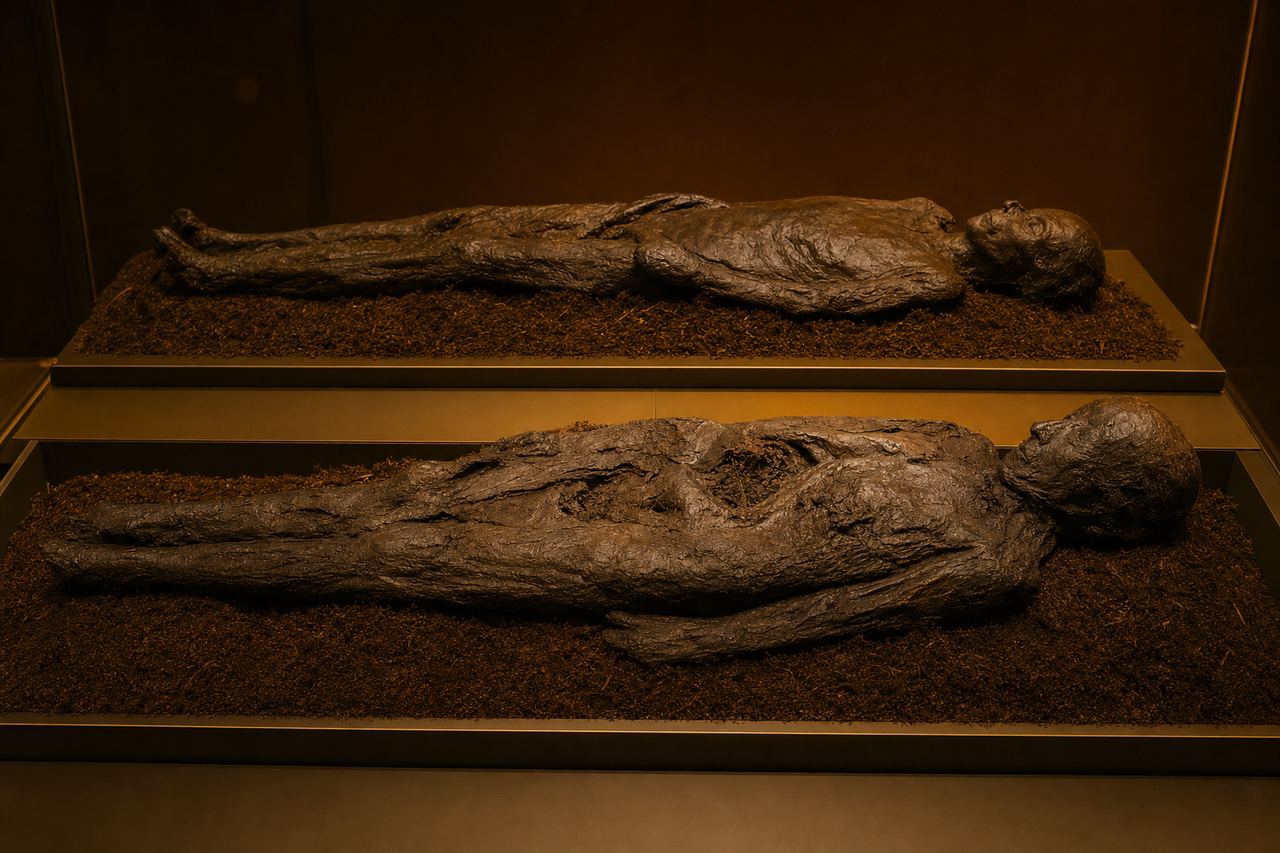
Initially assumed to be a man and a woman — a couple buried together — later osteological analysis established that both were male. The Weerdinge Men, as they became known, sparked a century of debate about their relationship, their deaths, and their meaning.
Who They Were
The two men died around 150 BCE, during the Iron Age in the Netherlands. One was taller than the other. One had intestines that had prolapsed outside his body — suggesting a severe abdominal wound, probably a disembowelling. The other showed no obvious trauma to the preserved portions of his body.
The shorter man's abdomen was opened and his intestines removed or displaced before or at death — a detail that has led some researchers to suggest this was a ritual killing involving disembowelling, a method documented in other Iron Age contexts as a sacrificial practice. But the evidence is not conclusive.
"Two men, together in the dark of the peat for two thousand years. Whatever their relationship in life, they are inseparable in death."— Modern commentary, Drents Museum
Lovers, Brothers, or Sacrifice Partners?
Three broad theories have been proposed for who the Weerdinge Men were to each other.

Lovers: The most romantically appealing theory. The position of the bodies — one with his arm around the other — is suggestive of intimacy. Some researchers argue that Iron Age northern European societies had no strict prohibition on same-sex relationships, and that the men may have been a couple buried together. Critics note that the "embrace" may simply reflect how the bodies settled after deposition in the bog.
Brothers or kinsmen: DNA analysis of bog bodies is technically challenging due to degradation, but future analysis may establish whether the two men were related. Being buried together might simply reflect a family relationship.
Ritual partners: In some interpretations of bog body sacrifice, victims were killed in pairs — perhaps representing complementary cosmic forces, or perhaps as a matched offering. The fact that one man appeared disembowelled while the other did not may indicate different roles in the same ritual.
The Dutch Bog Body Tradition
The Weerdinge Men are part of a remarkable tradition of bog body finds in the Dutch province of Drenthe. Over 40 bog bodies have been found in this region alone — an unusually high density that suggests this particular area of wetland held special ritual significance for Iron Age communities. The bodies span over a thousand years, suggesting that the bogs of Drenthe were used for ritual deposition across many generations.
Where They Are Today
The Weerdinge Men are displayed at the Drents Museum in Assen, the Netherlands, which holds one of the finest collections of bog body remains in Europe. They are shown as they were found — together. Whether they are there by choice, by family obligation, or by the will of priests who arranged their sacrifice and burial, they remain united after two thousand years of darkness and discovery.
Frequently Asked Questions
Where were the Weerdinge Men found, and where can they be seen today?
The Weerdinge Men were discovered in 1904 in the Bourtanger Moor peat bog near Weerdinge, in the Dutch province of Drenthe. They are currently on permanent display at the Drents Museum in Assen, Netherlands, where visitors can view the remarkably preserved remains alongside other bog body finds from the region.
How did one of the Weerdinge Men die?
One of the two men suffered catastrophic abdominal wounds — his intestines were pulled out of his body, a form of violence suggesting a ritualistic killing or a punishment of exceptional severity. The nature of the wounds, combined with the deliberate placement of the bodies in the bog, points strongly toward an intentional killing rather than an accident.
Were the Weerdinge Men really a man and a woman found embracing?
For over a century after their discovery, one of the individuals was believed to be female based on physical appearance. DNA analysis conducted in 2007 overturned this assumption, confirming that both bodies are male. They were found in a close embrace, making them one of the most visually striking and emotionally resonant bog body discoveries ever made.
How old are the Weerdinge Men, and why were they placed in a bog?
Radiocarbon dating places the deaths of the Weerdinge Men at around 160 BCE, during the Iron Age. The deliberate deposition of bodies in bogs during this period is widely interpreted by archaeologists as evidence of ritual sacrifice or judicial execution, since bogs held significant spiritual meaning for Iron Age communities in northwestern Europe.